
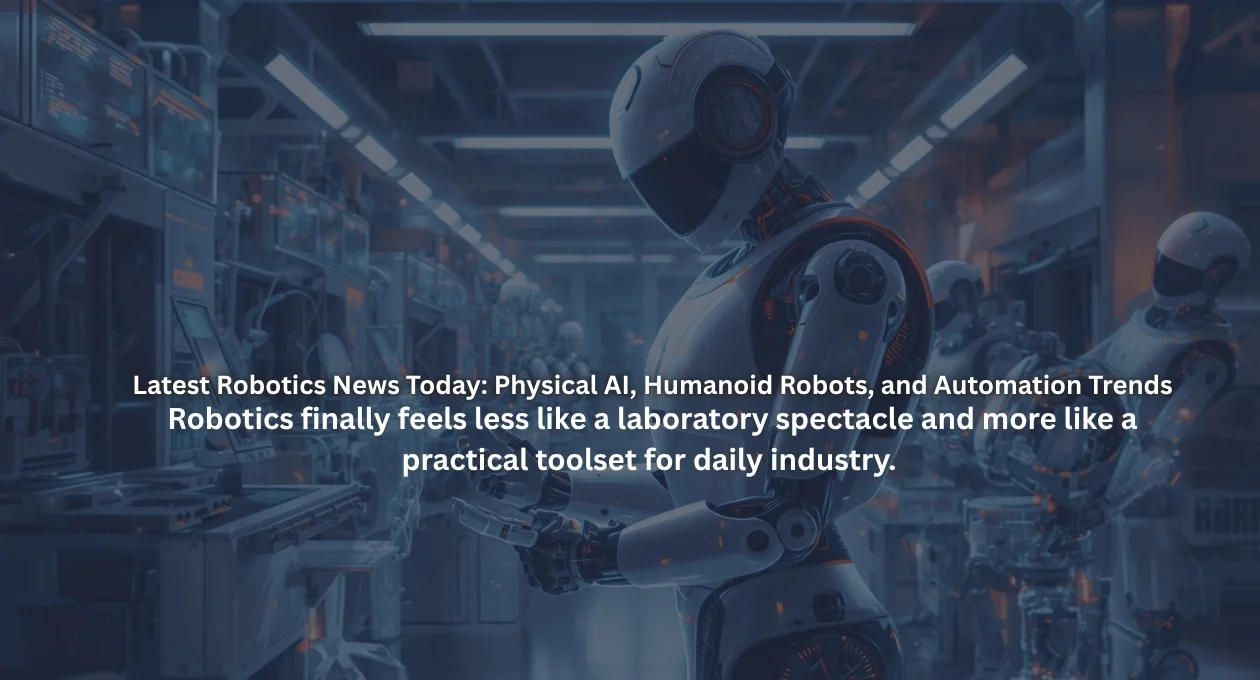
Latest Robotics News Today: Why This Moment Feels Different
Robotics finally feels less like a laboratory spectacle and more like a practical toolset for daily industry. Latest Robotics News Today shows a sharp pivot from glossy stage demos toward robots that carry, inspect, sort, assemble, assist, and learn from real environments. For readers of The Tek Zio, the key story is simple: AI robotics now has wheels, arms, sensors, and consequences. That’s exciting. It’s also a bit sobering because real-world usefulness demands patience, evidence, durable engineering, and plain accountability.
However, the big shift isn’t only about machines walking like people. Latest Robotics News Today reveals a deeper movement called physical AI, where software understands the world through cameras, force sensors, spatial maps, and repeated practice. Picture a chatbot leaving the laptop and learning to pack a box without crushing it. That’s the new frontier, and companies now race to prove robots can deliver value without turning every workplace into a science project, budget sink, or expensive circus.
Humanoid Robots Move From Stage Shows To Real Work
Humanoid robots grab attention because they look familiar, yet their business case depends on gritty tasks rather than theatrical hand waves. In Latest Robotics News Today, AGIBOT’s production milestone matters because it suggests embodied AI companies want volume, service networks, and customer deployment. A robot that rolls into a factory and repeats dull work for hours may look less cinematic than a backflip. Still, it pays the bills and earns trust through ordinary consistency, which buyers notice quickly when procurement gets serious.
Meanwhile, the humanoid race keeps splintering into sensible niches. Some machines focus on dexterous manipulation, where fingers, wrists, and tactile feedback matter more than dramatic walking. Others target logistics, electronics assembly, inspection, and hazardous work. That makes sense because human-shaped spaces already have shelves, doors, carts, buttons, and tools. If a robot can use those affordances without rebuilding the whole facility, adoption becomes less painful and far more persuasive for cautious buyers who hate disruption.
Physical AI Turns Robots Into Practical Teammates
Physical AI gives robots a better shot at usefulness because it connects perception, decision-making, and action. Latest Robotics News Today makes that link obvious across factories, warehouses, hospitals, and research labs. Instead of following brittle scripts, modern robots use vision-language-action models and simulation to interpret messy scenes. You can think of it like learning a kitchen: recipes help, yet real competence comes from touching pans, judging heat, and recovering when the spoon slips onto the floor.
Moreover, physical AI changes how businesses measure progress. A robot no longer wins praise because it completes one chore under perfect lighting. It earns trust by repeating tasks safely, handling small variations, and asking for help before causing chaos. That humble reliability matters. Fancy autonomy without guardrails becomes a liability, while modest autonomy with strong sensing can save time, reduce injuries, and free people from soul-draining repetition without pretending every job has vanished overnight.
Factory Automation Gains Fresh Momentum
Factories remain the most logical launchpad because they offer structure, predictable workflows, and measurable returns. Latest Robotics News Today connects that reality with rising industrial automation investment, especially in automotive, food, electronics, metalwork, and machinery. Robots thrive where tasks repeat with slight variation. For example, an AI-enabled arm can inspect parts, move components, or tend machines while workers handle exceptions, quality checks, and line improvements that require judgment rather than muscle memory or endless stamina.

Still, modern factory robotics isn’t a plug-and-play fairy tale. Managers must plan safety zones, train operators, update maintenance habits, and integrate robots with software stacks. The winners won’t simply buy the shiniest arm. They’ll map bottlenecks, compare downtime costs, and start with jobs where automation solves a specific pain. In other words, better robotics strategy beats robot shopping every time. That’s the kind of practical tech thinking The Tek Zio readers deserve when budgets matter.
Warehouse Robots Get Faster, Safer, And Smarter
Warehouses now behave like living organisms, with orders pulsing through aisles, inventory shifting hourly, and delivery promises tightening every season. Latest Robotics News Today highlights why autonomous mobile robots and smart pallet movers attract serious attention. They don’t need vanity. They need navigation, uptime, battery discipline, and clear communication with human teams. A small robot that prevents one mis-pick can beat a dazzling machine that only works during demos under perfect lighting and gentle applause.
Furthermore, warehouse autonomy pairs beautifully with digital twins and real-time analytics. A digital twin gives operators a living map of stock, traffic, and bottlenecks, while robots feed that map with fresh movement data. The result feels like air-traffic control for boxes. When used well, warehouse automation reduces walking time, lowers injury risk, and helps teams handle demand spikes without turning every shift into a marathon or every aisle into a traffic jam after lunch.
Medical Robotics Brings Specialist Care Closer
Medical robotics carries higher stakes because failure affects bodies, families, and trust. Latest Robotics News Today shows promising movement in remote surgery, robotic assistance, rehabilitation, and hospital logistics. The most useful systems don’t replace clinicians like some sci-fi villain. Instead, surgical robots extend precision, stabilize instruments, improve visualization, and help specialists reach patients who live far from advanced care centers. That’s not magic. It’s access with machinery, guided by trained people and strict procedures.
However, healthcare needs stricter proof than a warehouse or showroom. Hospitals must evaluate cybersecurity, latency, training, liability, cleaning protocols, and emergency fallback plans. A robot-assisted procedure can sound futuristic, yet every tool still needs clinical evidence and human accountability. That balance protects patients. It also builds long-term confidence, which matters more than hype. In medicine, slow and careful often beats fast and flashy because lives don’t fit neatly into beta tests or marketing slogans.
Robot Foundation Models Become The New Engine
Robot foundation models are becoming the hidden engine behind the latest breakthroughs. Latest Robotics News Today points toward systems that learn from demonstrations, synthetic data, videos, teleoperation, and simulated worlds. NVIDIA’s GR00T-style approach shows why developers want shared tools for robot learning, testing, and deployment. Instead of reinventing every skill from scratch, teams can adapt broader models to a specific body, task, and workplace, which shortens the road from prototype to pilot without skipping validation.
That said, robots still can’t simply “download common sense.” A model may understand an instruction, yet the body must grip the object, avoid a person, handle friction, and recover from surprise. This is where simulation, sensors, and reinforcement learning form a pragmatic tripod. The model supplies context. The hardware supplies contact. The testing process supplies humility. Without all three, robot intelligence remains charmingly clever and dangerously incomplete in a room full of moving people and fragile things.
Safety, Trust, And Regulation Shape The Race
Safety now sits at the center of every credible robotics conversation. Latest Robotics News Today keeps returning to robot safety standards, emergency stops, validation workflows, and governance because embodied systems interact with physical space. A bad chatbot answer may annoy you. A bad robot decision can drop a payload, block an exit, or injure someone. That difference changes everything, from product design to insurance paperwork and from lab pride to public responsibility across crowded workplaces.
Therefore, trustworthy robotics needs transparency as much as performance. Buyers should ask how a robot handles edge cases, what data it records, how updates get approved, and who owns responsibility during failure. Regulators will also press harder as robots enter public-facing areas. That scrutiny may feel tedious, yet it separates serious builders from carnival barkers. In a young market, boring safeguards can become a competitive advantage because trust compounds quietly and failures travel loudly.
What This Means For Workers, Businesses, And Buyers
Workers shouldn’t view every robot as a metal job thief. Latest Robotics News Today suggests a messier and more interesting reality. Robots often take over repetitive, hazardous, awkward, or endurance-heavy tasks, while people move toward supervision, maintenance, exception handling, and process design. That transition still requires training. Without reskilling, automation can feel like a locked door. With reskilling, it can become a ladder to safer, better-paid technical work that still needs human judgment.

For businesses, the smartest robotics decisions start with one question: what problem hurts enough to automate? Don’t chase humanoids because headlines sparkle. Start with cycle time, injury rates, labor gaps, quality defects, or wasted walking. Then choose the simplest robot that solves the pain. The Tek Zio takeaway is practical: AI robotics rewards clear thinking, patient testing, and honest math more than buzzwords, conference applause, or shiny demo videos that age badly.
FAQs About Latest Robotics News Today
Q1: What is Latest Robotics News Today mainly about?
It covers current advances in humanoid robots, factory automation, warehouse robots, medical robotics, robot AI models, and safety rules.
Q2: Why does physical AI matter?
Physical AI matters because it lets robots sense, decide, and act in real environments.
Q3: Are humanoid robots ready for homes?
Not fully. Latest Robotics News Today shows stronger progress in factories and warehouses first, where tasks stay clearer.
Q4: Will robots replace workers?
Some tasks will change, yet many roles will shift toward robot supervision, repair, programming, and workflow design.
Q5: Which robotics trend should businesses watch first? Watch embodied AI in logistics and manufacturing because those environments offer clearer returns. Final thought: Latest Robotics News Today isn’t just a headline theme. It’s a sign that robots are leaving the sandbox and entering the spreadsheet, where usefulness must prove itself before hype gets applause.
For more amazing blogs keep visiting The Tek Zio.


