
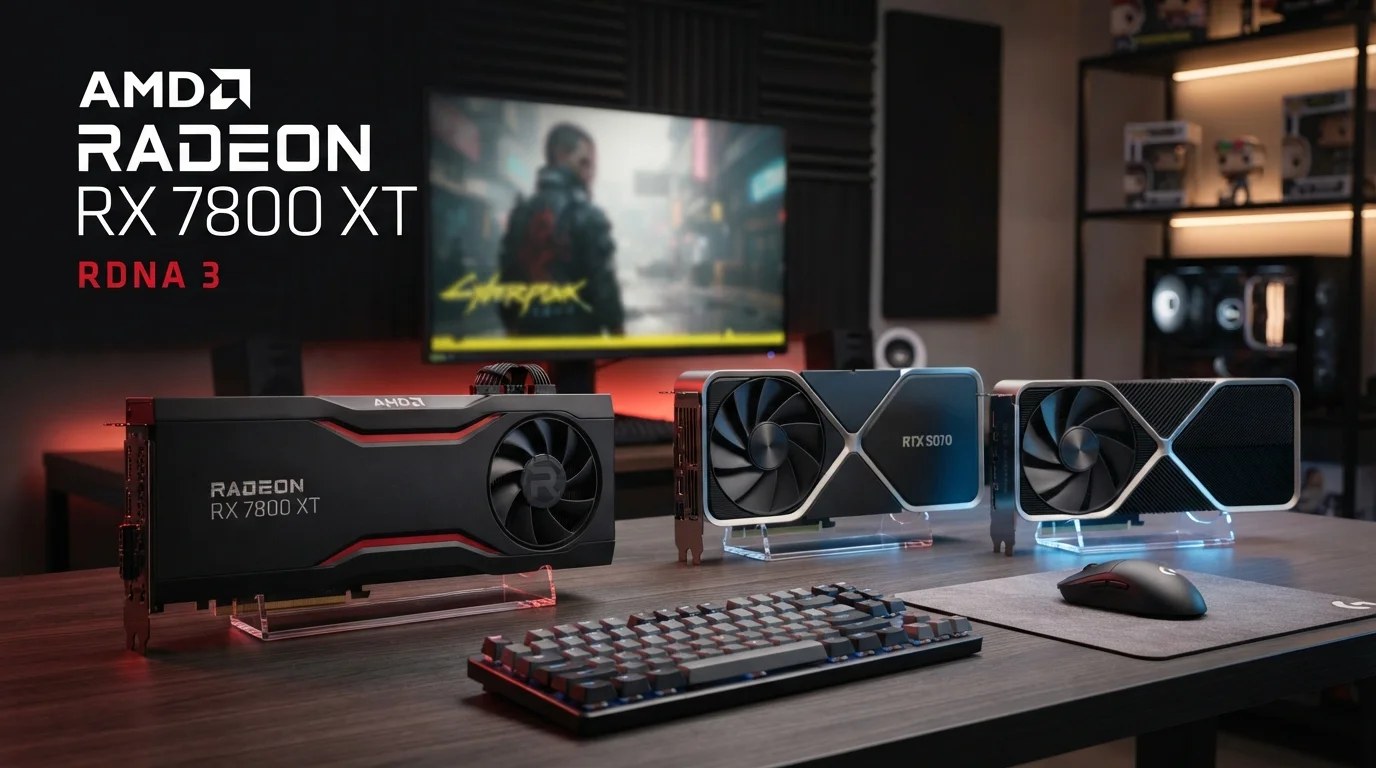
Finding the right RX 7800 XT equivalent depends on more than average FPS. You also need to consider 1440p performance, ray tracing, VRAM, power consumption, upscaling features, creator workloads, and current pricing.
The Radeon RX 7800 XT remains a 16GB 1440p-focused graphics card. AMD lists 16GB of GDDR6 memory, a 256-bit memory interface, up to 624 GB/s bandwidth, and 263W typical board power. AMD
Quick answer: for NVIDIA, the RTX 4070 Super remains a useful previous-generation comparison, while the newer RTX 5070 is the more relevant 2026 option to consider. On AMD’s side, the RX 7900 GRE is a higher-performance alternative, while the RX 7700 XT sits below the 7800 XT.
The right choice depends on whether you prioritize rasterized 1440p gaming, ray tracing, VRAM, creator software, or newer NVIDIA features.
What Is the NVIDIA Equivalent to the RX 7800 XT?
There is no single perfect NVIDIA equivalent because GPU performance changes by game, resolution, and rendering technology. The RTX 4070 Super remains a useful direct previous-generation comparison, while the RTX 5070 is the more current NVIDIA card to consider in 2026.
The RTX 4070 Super has 12GB of GDDR6X and 7,168 CUDA cores. NVIDIA’s current RTX 50-series moves to Blackwell, with the RTX 5070 offering 12GB of GDDR7 and 672 GB/s memory bandwidth. NVIDIA
The RX 7800 XT still has an important advantage in memory capacity: 16GB GDDR6 on a 256-bit interface. AMD
So the answer depends on what you mean by “equivalent”: RTX 4070 Super is useful for a same-generation comparison, while RTX 5070 is the more relevant newer NVIDIA alternative in a 2026 buying decision.
RX 7800 XT vs RTX 5070: Which Is Better in 2026?
The RTX 5070 changes the comparison because it belongs to NVIDIA’s newer Blackwell generation. NVIDIA lists 12GB of GDDR7 memory and 672 GB/s memory bandwidth for the RTX 5070. NVIDIA
The RX 7800 XT counters with 16GB of GDDR6, a 256-bit interface and up to 624 GB/s bandwidth. AMD
This makes the decision less straightforward than simply choosing the newer architecture. The RTX 5070 brings newer NVIDIA features and a newer platform, while the RX 7800 XT offers a larger VRAM capacity that can be valuable for high-resolution textures and longer-term 1440p use.
For ray tracing and NVIDIA’s newer feature set: RTX 5070 is the more attractive choice.
For 16GB VRAM and traditional rasterized gaming value: RX 7800 XT remains worth considering.
Best AMD Alternatives to RX 7800 XT
AMD’s alternatives depend on whether you want to spend less or move up in performance. The RX 7700 XT sits below the RX 7800 XT, while the RX 7900 GRE is a stronger card with the same 16GB memory capacity. AMD’s official RX 7800 XT specifications list 16GB GDDR6, 60 compute units and a 256-bit memory interface.
If you want the same AMD flavor, the RX 7900 GRE makes sense when the price gap stays small. It keeps 16GB VRAM and offers more GPU muscle. However, the RX 7700 XT can work if you mostly play esports, older AAA games, or optimized titles at 1440p. You can compare baseline AMD specs through AMD’s RX 7800 XT page and AMD’s RX 7700 XT page.
1440p Gaming Performance Comparison
For 1440p gaming, the 7800 XT equivalent should deliver high frame rates in modern games without forcing you to drop every visual setting. The RX 7800 XT was built for this exact sweet spot. It handles many AAA games at high or ultra settings, especially when you avoid heavy ray tracing. Tom’s Hardware’s June 2026 GPU hierarchy continues to show the RX 7800 XT as a strong 1440p-class card, with its tested 1440p Ultra result at 105.8 fps in that benchmark suite. The RTX 4070 Super is ahead at 109.8 fps, while the RX 7900 GRE reaches 113.9 fps in the same table. Tom’s Hardware.
The RTX 4070 Super often edges ahead in several newer games, while the RTX 4070 usually trails or trades blows depending on the title. Meanwhile, the RX 7900 GRE can stretch further if you want extra headroom. For example, a demanding open-world RPG may reward the 16GB VRAM and wider memory bus. A competitive shooter, on the other hand, may care more about raw frame pacing and CPU balance.
Ray Tracing and Upscaling Differences
A true 7800 XT equivalent changes shape once ray tracing enters the room. In traditional rasterized gaming, the RX 7800 XT looks strong for its price. Turn on heavy ray tracing, though, and Nvidia’s RTX cards usually gain the upper hand. The RTX 4070 Super benefits from stronger ray tracing hardware and excellent DLSS upscaling. That matters in games like Cyberpunk-style worlds, reflective racing games, and cinematic single-player titles.

AMD still offers useful tools through FSR, Radeon Super Resolution, and driver-level features. NVIDIA’s DLSS ecosystem can give GeForce cards an advantage in supported games, particularly when ray tracing is enabled. If you rarely use ray tracing, AMD’s value can look tastier than a hot pizza slice. If you love maximum lighting effects, Nvidia becomes more tempting. The best choice depends on whether you chase raw frames or prettier lighting.
VRAM, Memory Bus, and Future-Proofing
The RX 7800 XT has 16GB of GDDR6 memory, a 256-bit interface and up to 624 GB/s memory bandwidth. AMD
That extra capacity can be useful for demanding texture settings, mods and games that push VRAM usage. However, VRAM capacity alone does not determine gaming performance. GPU architecture, memory bandwidth, ray tracing performance, drivers and upscaling features all matter.
The RTX 4070 and RTX 4070 Super use 12GB memory, which still works well for 1440p today. Yet 16GB feels more comfortable for modded games, high-resolution texture packs, and occasional 4K gaming. If you plan to keep your GPU for four or five years, memory matters more. Still, VRAM alone doesn’t win everything. Architecture, cache, drivers, upscaling quality, and game optimization all pull their weight.
Productivity, Streaming, and Creator Workloads
NVIDIA also continues to emphasize its Studio ecosystem, NVENC encoding and RTX acceleration for creative workloads.
A good 7800 XT equivalent should also fit your non-gaming tasks if you edit videos, stream, or create content. Nvidia often wins in popular creator workflows because many apps support CUDA acceleration, NVENC encoding, and RTX-based AI features. That makes the RTX 4070 Super a smart pick for YouTubers, streamers, 3D artists, and editors who use Adobe, Blender, or similar tools.
The RX 7800 XT still supports AV1 encoding and handles casual creator tasks nicely. For gaming-first users who occasionally edit clips, AMD won’t feel weak. However, if your GPU earns money through editing, rendering, or AI tools, Nvidia’s software stack can save time. Time is money, after all. A faster export or smoother timeline may matter more than a few extra frames in one game.
Power Use, Cooling, and PSU Requirements
The 7800 XT equivalent should not only match performance; it should also fit your PC case and power supply. Your CPU choice also matters when building a balanced gaming PC, especially at 1440p. AMD lists the RX 7800 XT with a typical board power of 263W and recommends a 700W power supply. Many RTX 4070 and RTX 4070 Super models use less power, which can mean quieter fans, lower heat, and easier installation in compact builds.
That said, real-world thermals depend heavily on the specific card model. A thick triple-fan RX 7800 XT may run cooler than a small dual-fan RTX card. Don’t judge by the chip alone. Check the cooler design, warranty, noise reviews, and physical length before buying. A powerful GPU that barely fits your case can turn your clean build into a cable-management wrestling match.
Quick Comparison Table for Buyers
Use this table as a fast 7800 XT equivalent buying guide before checking live prices. The GPU market changes often, so treat this as a practical comparison rather than a fixed shopping rule. Your region, stock, used-card condition, and bundle offers can change the final value. Always compare the exact model, not just the GPU name, because coolers and factory clocks can vary.
| GPU | Best For | VRAM | Main Strength | Main Weakness |
|---|---|---|---|---|
| RX 7800 XT | 1440p gaming | 16GB GDDR6 | Strong raster performance and VRAM | Weaker ray tracing |
| RTX 5070 | Modern NVIDIA features | 12GB GDDR7 | Newer architecture, DLSS and ray tracing | Less VRAM |
| RTX 4070 Super | Previous-gen NVIDIA comparison | 12GB GDDR6X | Strong 1440p + ray tracing | Older generation |
| RX 7900 GRE | Faster AMD option | 16GB GDDR6 | More performance headroom | Higher power |
| RX 7700 XT | Lower-cost 1440p | 12GB GDDR6 | Cheaper entry point | Slower than 7800 XT |
The smartest purchase usually comes down to price. If the RTX 4070 Super costs only a little more than the RX 7800 XT, it becomes attractive for ray tracing and content creation. If the RX 7800 XT is much cheaper, it can be the better gaming deal. If the RX 7900 GRE appears close in price, grab a coffee and compare carefully because it may offer the best long-term value.
Final Verdict: Which GPU Should You Buy?
It’s the biggest 2026 issue in the article. It offers strong 1440p performance, better ray tracing, excellent upscaling, and broad creator support. The regular RTX 4070 can work if you find it at a noticeably lower price, but it no longer feels like the strongest direct match. For pure gaming value, AMD’s RX 7800 XT still holds its ground confidently.

If you prefer AMD, look at the RX 7900 GRE when pricing makes sense. It gives you more performance while keeping 16GB VRAM. If your budget is tighter, the RX 7700 XT can still handle 1440p with sensible settings. In simple words, choose Nvidia for features and ray tracing. Choose AMD for VRAM and raster value. Your monitor, games, and local prices should make the final call.
FAQs About the 7800 XT Equivalent
Is the RTX 5070 an RX 7800 XT equivalent?
The RTX 5070 is a relevant newer NVIDIA alternative to the RX 7800 XT, but it is not an exact one-to-one equivalent. The RTX 5070 uses NVIDIA’s Blackwell architecture and 12GB GDDR7, while the RX 7800 XT uses AMD’s RDNA 3 architecture with 16GB GDDR6. The better choice depends on gaming performance, ray tracing, VRAM requirements, features and price.
What is the best 7800 XT equivalent from Nvidia?
The best Nvidia match is usually the RTX 4070 Super. It competes well at 1440p, performs better in ray tracing, and offers DLSS Frame Generation. The RX 7800 XT gives you more VRAM, so AMD still looks better if you care about 16GB memory and traditional rasterized gaming.
Is the RTX 4070 better than the RX 7800 XT?
The RTX 4070 is better for power efficiency, DLSS, and some creator workloads. However, the RX 7800 XT often offers stronger traditional gaming performance and more VRAM. If both cards cost the same, many gamers may prefer AMD. If you need Nvidia features, the RTX 4070 still makes sense.
Is the RTX 4070 Super faster than the RX 7800 XT?
The RTX 4070 Super is often faster overall, especially with ray tracing enabled. It also brings stronger upscaling support through DLSS. However, it has 12GB VRAM compared with 16GB on the RX 7800 XT. That makes the final choice depend on pricing and the games you play.
Is the RX 7900 GRE better than the RX 7800 XT?
Yes, the RX 7900 GRE is generally a stronger AMD card than the RX 7800 XT. It offers more performance headroom while keeping 16GB VRAM. The catch is price. If the RX 7900 GRE costs only slightly more, it can be a smart upgrade. If the gap is large, the RX 7800 XT looks better.
Is the RX 7800 XT good for 4K gaming?
The RX 7800 XT can handle 4K in many games with adjusted settings, but it works best at 1440p. Its 16GB VRAM helps at higher resolutions, though raw GPU power still matters. For consistent 4K ultra gaming, a stronger GPU like RX 7900 XT, RTX 4070 Ti Super, or better makes more sense.
For more Information keep visiting Thetekzio.


