
What Is Pharyvac Surgical Technology?
Pharyvac surgical technology is a medical device innovation developed to address a common challenge in ear, nose, and throat (ENT) surgery: managing blood, smoke, and debris during endonasal procedures.
Developed through Mount Sinai BioDesign, the Pharyvac suction catheter is designed to provide continuous aspiration near the upper airway. Its purpose is to help surgical teams manage fluid and debris while reducing interruptions caused by repeated manual suctioning.
The device is particularly relevant to endoscopic sinus and skull-base surgery, where clear visualization is important. However, its proposed benefits should be distinguished from outcomes demonstrated in clinical studies.
This guide explains how the technology is designed to work, the problems it aims to solve, and what publicly available research tells us about its development.
Why ENT Surgery Needs Smarter Aspiration
Picture a windshield during heavy rain; even an expert driver needs clear glass. Surgeons face a similar challenge when blood or debris blocks the endoscope. In endonasal surgery, tiny visual interruptions can slow decisions and force extra suction passes. Pharyvac surgical technology tries to reduce that stop-start pattern by managing fluid and particles near the throat before they become a bigger nuisance. That’s not glamorous. It’s important, because clean visualization keeps delicate anatomy from turning into guesswork.
However, the issue goes beyond visibility. Surgical staff may face aerosol exposure, patients may swallow blood, and teams may rely on throat packs with their own drawbacks. The public SBIR award record names three target problems: staff exposure, patient blood ingestion, and obstructed endoscopic visualization. By addressing these together, pharyvac surgical technology sits at the intersection of patient safety, clinician protection, and operating-room efficiency, which hospitals increasingly measure with hawk-like attention.
How the Device Works in the Operating Room
Pharyvac is designed as a specialized aspiration catheter for selected endonasal surgical procedures. Its proposed design uses a balloon or cuff to support positioning while connected suction removes blood, fluid, smoke, and debris from the surgical area.
Unlike intermittent manual suction, the device aims to provide continuous aspiration. This could help reduce interruptions during procedures where the surgeon needs a clear endoscopic view.
The device’s effectiveness depends on factors such as correct placement, suction performance, and the type of surgery being performed. Its clinical advantages must be evaluated through appropriate testing rather than assumed from the design alone.
Key Benefits for Surgical Teams and Patients
The main goal of pharyvac surgical technology is to improve the management of blood, smoke, and debris during selected ENT procedures.
Potential benefits for surgical teams include fewer interruptions for manual suctioning, better management of material near the surgical airway, and reduced exposure to airborne particles.
Potential benefits for patients include limiting blood ingestion during surgery and reducing related postoperative discomfort.
These are intended benefits rather than guarantees. The NIH-funded development project identified several outcomes for further evaluation, including aspiration performance, device safety, and procedural efficiency.
Clinical evidence is essential before concluding that the device consistently improves patient outcomes or reduces operating time.

Pharyvac Surgical Technology vs Traditional Throat Packs
Traditional throat packs can help catch blood and debris, yet they add another task to the surgical checklist. Teams must place them properly, monitor them, and remove them reliably. In some cases, packs can also contribute to irritation or complications. Pharyvac surgical technology proposes a different route by using active aspiration rather than passive absorption. The contrast feels like using a sump pump instead of a towel when the basement starts taking on water.
| Feature | Traditional Throat Pack | Pharyvac Device Concept |
|---|---|---|
| Main function | Absorbs blood and fluid | Designed for continuous suction |
| Method | Passive absorption | Active aspiration |
| Placement | Typically placed in the pharynx | Designed for the upper airway |
| Fluid management | Collects material in absorbent packing | Aims to evacuate fluid and debris |
| Clinical evidence | Established clinical use, with known limitations | Further clinical evaluation is needed |
| Main consideration | Placement, monitoring and complete removal | Safety, effectiveness and suitability for the procedure |
The main difference is how the two approaches manage fluid. A traditional throat pack absorbs material, while the Pharyvac concept uses active suction to remove it.
However, the two methods should not be considered interchangeable without clinical evidence. Their suitability depends on the procedure, patient needs, and surgical team’s judgment.
The Mount Sinai BioDesign Origin Story
Every useful device begins with a stubborn problem. Pharyvac surgical technology grew from Mount Sinai BioDesign work during the COVID-19 era, when rhinology and endonasal surgery faced new scrutiny around aerosols and workflow. The project came from a clinician-engineer environment, with Alfred Marc Iloreta, MD, and Turner S. Baker, PhD, connected to early development. That origin gives the device a credible needs-first foundation rather than a gadget-first story with shiny marketing varnish.
According to Mount Sinai BioDesign, Pharyvac originated during the COVID-19 pandemic, when concerns about aerosol exposure highlighted the need for better fluid and debris management during endonasal surgery. The project was co-developed by Alfred Marc Iloreta, MD, and Turner S. Baker, PhD, before progressing into an independent medical device company.
In plain terms, this technology appears to follow the best medtech playbook: observe surgery, identify repeated friction, prototype, test, and iterate. Duke University also highlighted engineering involvement through Megan Christy’s work on aspiration-device development. This matters because operating-room products live or die by details: cuff shape, suction behavior, placement comfort, tubing position, and setup speed. Tiny design flaws can annoy teams; elegant ones disappear into the workflow like good stagehands.
Research, Funding, and Regulatory Status
Pharyvac surgical technology received support through a 2024 National Institutes of Health (NIH) Small Business Technology Transfer (STTR) Phase I award. The funded project focused on developing and evaluating a balloon aspiration catheter for endonasal surgery.
The project’s proposed work included testing aspiration performance in a realistic nasal and oral model, evaluating safety and feasibility in an animal model, and preparing for further clinical development.
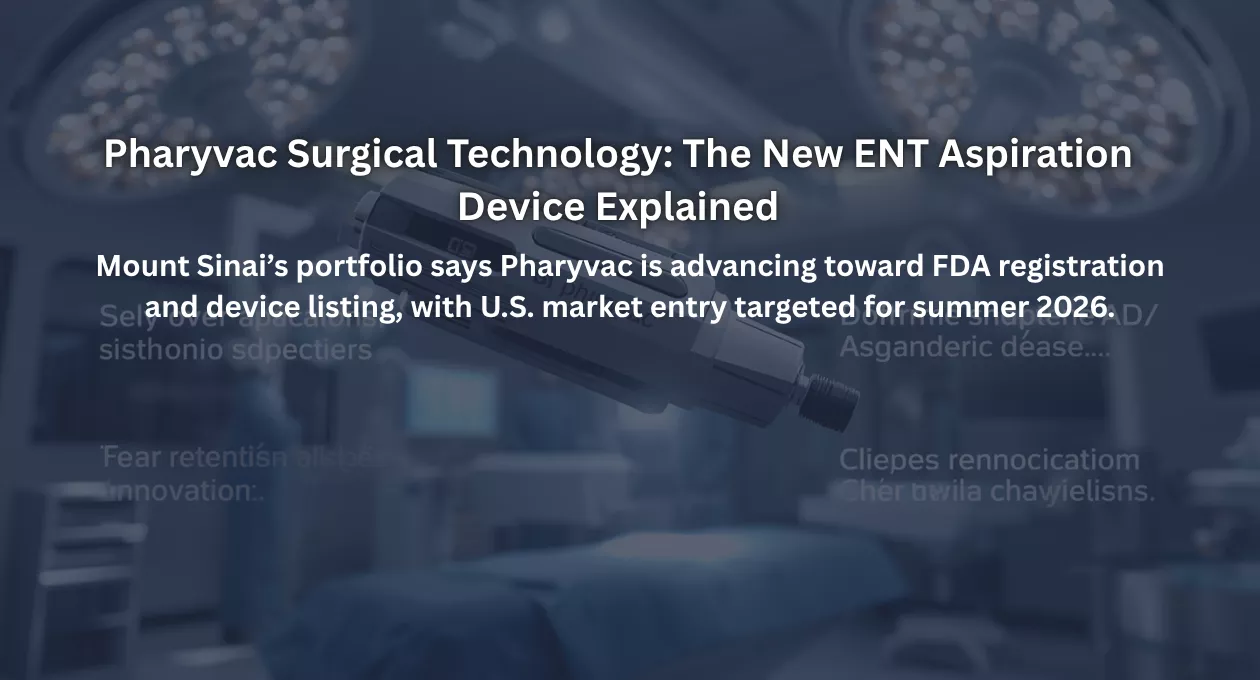
Mount Sinai subsequently reported that the device was undergoing human trials in France toward the end of 2025. Its BioDesign portfolio also described plans for FDA registration, device listing, and a potential U.S. commercial launch in 2026.
These reports describe development milestones and plans, not proof that all clinical outcomes have been established. Regulatory listing, marketing authorization, and clinical effectiveness are separate matters that readers should not confuse.

Where It Fits in the Future of Surgery
Surgery’s next chapter won’t belong only to robots, AI, or augmented-reality headsets. Many advances will come from humble devices that remove one nagging obstacle. Pharyvac surgical technology fits that pattern because it targets surgical visibility, fluid control, and exposure reduction at once. It’s not trying to replace the surgeon. Instead, it may help the surgeon work with fewer interruptions and a cleaner anatomical canvas, which can matter more than flashy dashboards.
Additionally, this technology aligns with a broader push toward minimally invasive surgery, smarter suction, and more disciplined operating-room ergonomics. As robotics and imaging improve, fluid management must keep pace. A crystal-clear 4K endoscope loses value when blood clouds the view. That’s why aspiration innovation matters. It supports the entire surgical stack, from human judgment to digital visualization, like good plumbing underneath a beautiful building. Nobody applauds it, yet everyone needs it.
What Hospitals Should Watch Before Adoption
Before considering a new surgical device, hospitals need reliable information about its safety, performance, and practical use.
For Pharyvac, important questions include whether the device works with existing suction systems, how easily surgical teams can learn to use it, and whether it performs consistently across different procedures.
Hospitals should also review available clinical evidence, regulatory status, infection-control requirements, and total costs. A promising design alone is not enough to establish that a device is suitable for routine use.
Pharyvac is an example of how medical innovation can focus on solving a specific operating-room problem. Its long-term role will depend on clinical results, regulatory requirements, and real-world experience.
Final Thoughts on Pharyvac Surgical Technology
Pharyvac surgical technology highlights an important area of medical innovation: improving fluid and debris management during ENT surgery.
Its proposed approach to continuous aspiration may offer practical advantages, but the most important questions concern patient safety, clinical effectiveness, and regulatory status.
As further research becomes available, surgeons and healthcare organizations will be better positioned to evaluate where this technology fits into modern surgical practice.
For more amazing blogs keep visiting The Tek Zio.


