
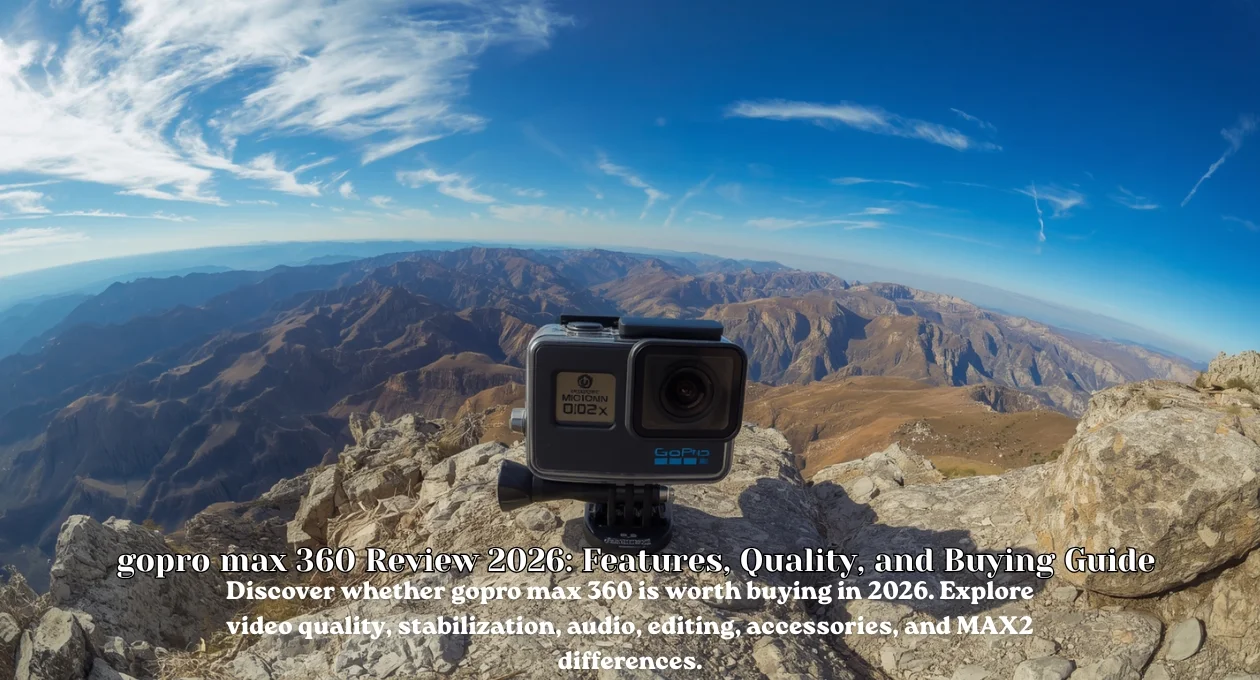
Type “GoPro Max 360” into a search bar right now and you land on two different cameras at two very different prices. Same name. Different specs. That mix-up costs people money every week. GoPro reissued its original Max 360 camera in 2025 with a lower price a new USB-C port and a universal mount while GoPro Max 2 arrived as the company’s newer flagship with true 8K 360 video. Neither product page tells you which one fits your footage or your budget.
This GoPro Max review breaks that down. You will find the real specs behind the GoPro Max 360 camera how it stacks up against GoPro Max 2 and Insta360 X5 and where the extra money on the newer models actually goes. By the end you should know whether the original Max 360 covers what you shoot or whether the newer hardware is worth paying for.
Quick Answer: The GoPro Max 360 is the 2025 reissue of GoPro’s original 360 degree camera. It shoots 5.6K30 spherical video and 16.6MP 360 photos runs HyperSmooth stabilization and is waterproof to 5 meters (16 feet) without a housing. It now charges over USB-C and uses a universal quarter-20 mount. Priced well under GoPro Max 2’s $499.99 true 8K flagship it suits everyday vlogging and travel more than heavy VR or YouTube 360 work.

What Is the GoPro Max 360 Camera?
A 360 degree camera is built with two lenses pointed in opposite directions instead of one. The GoPro Max 360 uses this dual lens camera design so its two lenses record everything around it at once then in-camera stitching merges the two hemispheres into a single spherical video camera file inside the Quik app. As a consumer 360 camera GoPro Max 360 trades some resolution for a friendlier price and a simpler workflow than the newer models.
GoPro’s Hero line stays single lens by design capturing only what sits directly in front of it while Max 360 adds the second lens for full coverage. Because it captures a full 360 action camera field of view you can pull a normal looking POV shot from any direction in the sphere after recording including an angle you never actually pointed a lens at. Six built-in microphones also record immersive 360 audio matching sound direction to whatever angle you reframe into later with wind reduction built in for outdoor use.
GoPro Max 360 Full Specs and Standards
GoPro Max 360 video tops out at 5.6K resolution at 30 frames per second and GoPro Max 16.6MP photos capture the entire sphere in one still. Switch to GoPro Max single lens mode also called HERO mode and the camera behaves like a standard Hero camera up to 1440p producing normal non-360 footage for moments when you do not need the full field of view. GoPro Max waterproof rating stands at 5 meters (16 feet) without a housing based on GoPro’s own spec page.
The 2025 reissue swapped the original micro USB port for USB-C following the connector standard set by USB-IF and added a universal quarter-20 GoPro Max mount so tripods and rigs from outside GoPro’s own catalog attach directly. The reissue also picked up new software through the Quik Engine including object tracking and CameraFX camera movements like Spin Flip Roll and Wobble.
| Spec | GoPro Max 360 (2025 reissue) |
|---|---|
| 360 video | 5.6K30 |
| 360 photo resolution | 16.6MP |
| Single lens (HERO) mode | Up to 1440p |
| Stabilization | HyperSmooth |
| Waterproof | 5m (16ft) no housing needed |
| Microphones | 6 for immersive 360 audio |
| Charging | USB-C |
| Mount | Universal 1/4-20 |
GoPro Max 360 vs GoPro Max 2 vs Insta360 X5
If you are cross shopping the real question is not whether GoPro Max 360 is good on its own. It is whether you need what the newer models add. And that comes down to two things: resolution and price. GoPro Max 2 launched at $499.99 with true 8K 360 video according to GoPro’s own announcement along with easy to swap lenses and 10-bit color for wider dynamic range during grading something the original Max 360 does not offer.
Insta360 X5 launched the same year at $549.99 with 8K 360 video and larger image sensors per Insta360’s official store listing which is the main reason its low light image quality edges out GoPro Max 360. These GoPro Max vs Insta360 comparisons tend to focus only on resolution numbers missing the price and ecosystem trade-offs that matter more day to day. Video resolution differences among these three cameras matter less than where you plan to watch the final clip. GoPro Max 360 keeps HyperSmooth stabilization and the Quik app workflow that existing GoPro owners already know.
| GoPro Max 360 | GoPro Max 2 | Insta360 X5 | |
|---|---|---|---|
| Price position | Budget tier reissued 2025 | $499.99 launch | $549.99 launch |
| 360 resolution | 5.6K30 | True 8K | 8K30 |
| Lenses | Fixed | Twist-and-go replaceable | Replaceable |
| Mount | Universal 1/4-20 | Magnetic and 1/4-20 | 1/4-20 |
| Best for | Best 360 camera for beginners on a budget | Heavy creators YouTube 360 VR content creation | Low light shooting replaceable-lens durability |
A common GoPro Max vs Hero question also comes up here. Single lens mode on Max 360 gets close to a dedicated Hero camera’s output but is not identical since the sensor and lens design behind it were built for 360 capture first.
Getting Your First Clean 360 Shot
Editing 360 footage is easier inside Quik than in a standard timeline editor built for flat video and getting a clean shot starts before you even hit record. Follow these steps the first time you shoot with a GoPro Max 360 action camera.
- Mount the camera on an invisible selfie stick or extension pole for 360 shots so the pole itself disappears once the software processes the clip.
- Turn on horizon leveling in the Quik app settings so tilted footage straightens automatically during editing.
- Check both lenses for smudges or water droplets before recording since a dirty lens shows up in the visible field of view on that side of the sphere.
- Record in full 360 mode instead of single lens capture if you are unsure which angle you want since you can crop down later but cannot add missing footage back afterward.
- Open the file in the Quik app or the desktop app and reframe 360 video after the fact dragging the view to follow the action instead of aiming the camera live.
- Export at 4K resolution or 1080p once you have picked your framing matching the aspect ratio and resolution to wherever you plan to post it then share straight to Facebook and YouTube from inside the app.

Terms Every GoPro Max 360 Buyer Should Know
Reframe: picking a flat normal looking clip out of the full 360 sphere after recording instead of committing to one angle while shooting.
In-camera stitching: the process where footage from the two lenses merges into one spherical video file inside the camera or the Quik app.
PowerPano: a GoPro feature that captures an ultra wide panorama photo from the 360 sensor without physically panning the camera.
360 TimeWarp: a time lapse mode that keeps the full spherical field of view while compressing footage shot over a longer period.
Tiny Planet: a CameraFX effect that warps a 360 clip into a small curved globe a popular look for TikTok and Instagram edits.
Single lens capture (HERO mode): shooting with just one of the two lenses active producing normal non-360 footage similar to a standard Hero camera.
Best Uses for a GoPro Max 360 Action Camera
A GoPro Max 360 action camera earns its keep in situations where you cannot predict the best angle before you shoot.
- Vlogging: hold the invisible pole out and get third-person drone-like footage of yourself without a second camera operator including group selfies where everyone fits in frame automatically.
- Adventure and action sports: mount it on a helmet for ski snowboard or mountain bike runs and reframe later to catch whoever is riding beside you.
- Travel: capture a full room or street scene once then pull multiple clips from the same file instead of re-shooting each angle. Invisible pole shots have become some of GoPro’s most iconic 360 shots shared across TikTok and Instagram.
- Underwater: the 5m (16ft) waterproof 360 rating covers shallow snorkeling and rain without extra gear. For deeper dives The Tek Zio’s coverage of the waterproof point-and-shoot camera category walks through dedicated options.
- VR content creation: export the raw spherical file so viewers can look around inside a headset instead of watching a flat frame.
- Everyday photos and videos: switch to single lens mode for ordinary clips when the full sphere is not needed.
If you shoot mostly flat video and only want 360 occasionally it is worth comparing against The Tek Zio’s picks for the best vlogging cameras before settling on a 360-only setup.
Battery Life and Real World Runtime
GoPro Max battery life depends heavily on resolution and stabilization settings and it is where 360 shooting costs the most since two image sensors and constant stitching draw more power than a single lens camera. GoPro has not published a fresh spec-page runtime figure for the 2025 GoPro Max 360 reissue as of this update so treat any number you see elsewhere as until you check GoPro’s own tech specs tab directly.
What is confirmed per GoPro’s own announcement is that the newer GoPro Max 2 runs close to 80 minutes at 5.6K30 in 360 mode. Runtime on the original Max 360 hardware should land in a similar range or somewhat lower given its older sensor and processor but that is not a guaranteed figure.
Cold weather GPS use and continuous HyperSmooth stabilization all cut into the runtime you will actually see in the field. A GoPro Max dual battery charger and a spare Enduro-style battery cost far less than losing footage mid-run on a ski trip or a long hike. Shooting mostly in single lens mode instead of full 360 stretches sessions noticeably since only one image sensor stays active and nothing is being stitched in real time.
GoPro Max 360 Accessories Worth Buying
The universal quarter-20 mount on the 2025 reissue opened GoPro Max accessories up beyond GoPro’s own catalog and mounts and accessories originally built for other cameras now work without an adapter. One catch. Check mount compatibility with your specific Max 360 version before buying third-party gear since the older micro USB model and the 2025 USB-C reissue are not identical hardware.
Does every third-party mount just work out of the box? Mostly yes as long as it uses the standard quarter-20 thread. Older GoPro-specific clips built for the original mount are the exception.
- GoPro Max lens caps or protective covers since a scratched lens ruins footage on that entire side of the sphere.
- A GoPro Max case for travel given the exposed dual lens design compared to a flat action camera body.
- A GoPro Max dual battery charger useful once you are carrying spares for a full day of shooting.
- A floating grip or extension pole for 360 shots near water where a sinking camera is otherwise gone for good.
- A fast high-capacity microSD card for GoPro Max since 360 video files run larger than flat 4K footage at the same shooting time.
- A small tripod or rig built for a mirrorless body now attaches directly through the standard mount. If you are weighing a heavier photography setup alongside your action camera The Tek Zio’s Sony A7 II coverage walks through a full mirrorless option worth comparing.
Quik’s cloud editing support also means large spherical video files do not have to eat your device’s storage while you edit which matters once you are shooting several 360 clips a day.
Specs and Standards Callout
The GoPro Max 360 you buy today runs on three governing standards worth knowing before you buy: USB-C charging a universal quarter-20 mount and GoPro’s own waterproof rating.
- USB-C: the 2025 reissue replaced the original micro USB port following the connector standard set by USB-IF and used across most current consumer electronics.
- Quarter-20 (1/4-20) mount: a standard photography thread size meaning tripods mounts and rigs built for cameras far outside GoPro’s own catalog now attach without an adapter.
- Waterproof to 5m (16ft): this rating comes from GoPro’s own published spec page and applies without an external housing unlike some older action cameras that need one for any water exposure.
Stats and Data
| Data Point | Year | Source | Why It Matters |
|---|---|---|---|
| Original GoPro Max launch price $499.99 reissued in 2025 at a lower GoPro Max price | 2019 / 2025 | GoPro | Shows how far the entry cost has dropped since launch |
| GoPro Max 2 launch price $499.99 true 8K 360 video | 2025 | GoPro’s official announcement | Sets the current flagship price and resolution ceiling |
| Insta360 X5 launch price $549.99 8K 360 video | 2025 | Insta360’s official store | Gives a direct outside-GoPro price and resolution comparison |
| GoPro Max 2 runtime near 80 minutes at 5.6K30 360 | 2025 | GoPro’s official announcement | Sets a realistic runtime expectation for 360 shooting at top resolution |
| Waterproof rating of 5m (16ft) without a housing | 2025 | GoPro’s spec page | Confirms how far the camera can go into water safely |
The original 2025 reissue’s own runtime figure was not published on GoPro’s spec page at the time of this update so it is marked rather than stated as settled fact.
Common Mistakes When Buying a 360 Camera
Most of these come down to skipping the spec sheet. And they are easy to avoid once you know what to check.
- Expecting 8K 360 video: GoPro Max 360 tops out at 5.6K30. If 8K 360 matters to you that is GoPro Max 2 or Insta360 X5 territory not this camera.
- Assuming the lower price signals a defect: the 2025 reissue is a lineup decision not a clearance of broken stock.
- Skipping a spare battery: 360 recording drains power faster than flat single lens capture especially at full resolution with stabilization running.
- Blocking part of the field of view: fingers straps or a poorly placed mount show up in the finished sphere on whichever side they sit.
- Editing raw spherical files in a standard video editor: without reframing first inside Quik footage looks distorted and wraps strangely.
- Buying third-party mounts before checking your exact hardware version: the older micro USB model and the 2025 USB-C reissue are not the same camera underneath.
Reality Check: Will You Actually Notice the Difference
Most people posting to Instagram or TikTok at 1080p or 1440p will not see a real difference in video quality between GoPro Max 360 and GoPro Max 2 once the platform compresses the export. The extra resolution on Max 2 and Insta360 X5 shows up mainly when you punch into a tight crop or export for YouTube or VR at full size.
That is not a knock on the newer cameras. It describes where video quality gains actually show up. But here is the part most buying guides skip: resolution only matters once you export past what your platform compresses anyway. If your workflow ends at a phone screen or a social feed jumping straight to the pricier option pays for headroom you are unlikely to use. If you rely on 4K exports at wide crops for YouTube or you build 360 content for a headset the sensor upgrade is where the extra money goes. Whether GoPro Max 360 is the best 360 camera for you depends on your export target not the spec sheet alone.
Who Should Buy Which
Buying the right 360 camera comes down to where your footage ends up not which model is newest.
- Budget buyer and first 360 camera: GoPro Max 360 since it covers the core feature set at the lowest entry cost. Buy GoPro Max 360 here rather than the newer flagship if your exports rarely go past 1440p.
- Heavy creator exporting tight crops for YouTube: GoPro Max 2 for the true 8K sensor and 10-bit color.
- Shooter who wants larger image sensors and replaceable lenses outside the GoPro ecosystem: Insta360 X5.
- Existing GoPro subscriber: GoPro Max 360 since GoPro’s camera replacement policy already covers it and the Quik app workflow carries over from any other GoPro camera you own.
FAQs
Is the GoPro Max 360 still worth buying in 2026?
Yes for casual 360 vlogging travel and everyday clips exported to 1080p or 1440p for social platforms. It gives you HyperSmooth stabilization 360 audio and a universal mount at a lower price than GoPro Max 2. If you need true 8K 360 video or plan tight crops for YouTube GoPro Max 2 or Insta360 X5 fit that use case better.
What is the difference between GoPro Max 360 and GoPro Max 2?
GoPro Max 360 tops out at 5.6K30 spherical video while GoPro Max 2 captures true 8K 360 video with twist-and-go replaceable lenses and 10-bit color according to GoPro’s own announcement. Max 2 also launched at a higher price. Both run the same Quik app ecosystem and HyperSmooth stabilization approach.
Is the GoPro Max 360 waterproof without a case?
Yes up to 5 meters (16 feet) based on GoPro’s published spec page with no separate housing required. That covers shallow snorkeling pool use and rain though deeper dives still call for dedicated waterproof gear.
How long does the GoPro Max 360 battery last?
GoPro has not published a confirmed runtime figure for the 2025 reissue as of this update so treat any number elsewhere as unverified until you check GoPro’s own spec page. GoPro Max 2 runs close to 80 minutes at 5.6K30 in 360 mode which gives a rough reference point though the original hardware may run somewhat shorter.
Can the GoPro Max 360 shoot regular non-360 footage?
Yes through single lens capture also called HERO mode which uses just one of the two lenses for normal video up to 1440p. This works well when the full 360 degree field of view is not needed.
Does a GoPro subscription cover the GoPro Max 360?
GoPro’s camera replacement policy applies to Max 360 the same way it does to other current GoPro cameras under an active subscription. Confirm current subscription terms directly on GoPro’s site since coverage details can change.
What mounts work with the GoPro Max 360?
The 2025 reissue uses a universal quarter-20 mount so tripods rigs and accessories built for cameras outside GoPro’s own catalog attach directly. Older GoPro-specific mounts built for the original micro USB version may need an adapter.
Is the GoPro Max 360 or Insta360 X5 better for beginners?
GoPro Max 360 is the simpler and cheaper entry point if you already know the Quik app or own other GoPro cameras. Insta360 X5 costs more but adds larger image sensors and replaceable lenses worth it if low light performance matters more than staying inside one ecosystem.
Conclusion
GoPro Max 360 earns its place as the budget entry point into spherical video rather than the resolution leader of the lineup. It keeps HyperSmooth stabilization 360 audio and a now-universal mount at a price well under GoPro Max 2 or Insta360 X5 and for footage headed to Instagram TikTok or a family group chat that trade holds up. If you are still weighing action cameras outside the 360 category entirely The Tek Zio’s roundup of the best budget action cameras covers flat-lens options at similar price points worth comparing before you commit.
Editorial Standards
The Tek Zio builds buying guides from manufacturer spec pages official press announcements and independent testing coverage rather than in-house hardware testing. Every price spec and figure in this article traces back to GoPro’s own product and press pages or Insta360’s official store listing checked as of September 13 2026. Where a figure could not be confirmed directly from the manufacturer it is marked rather than stated as settled fact.


