
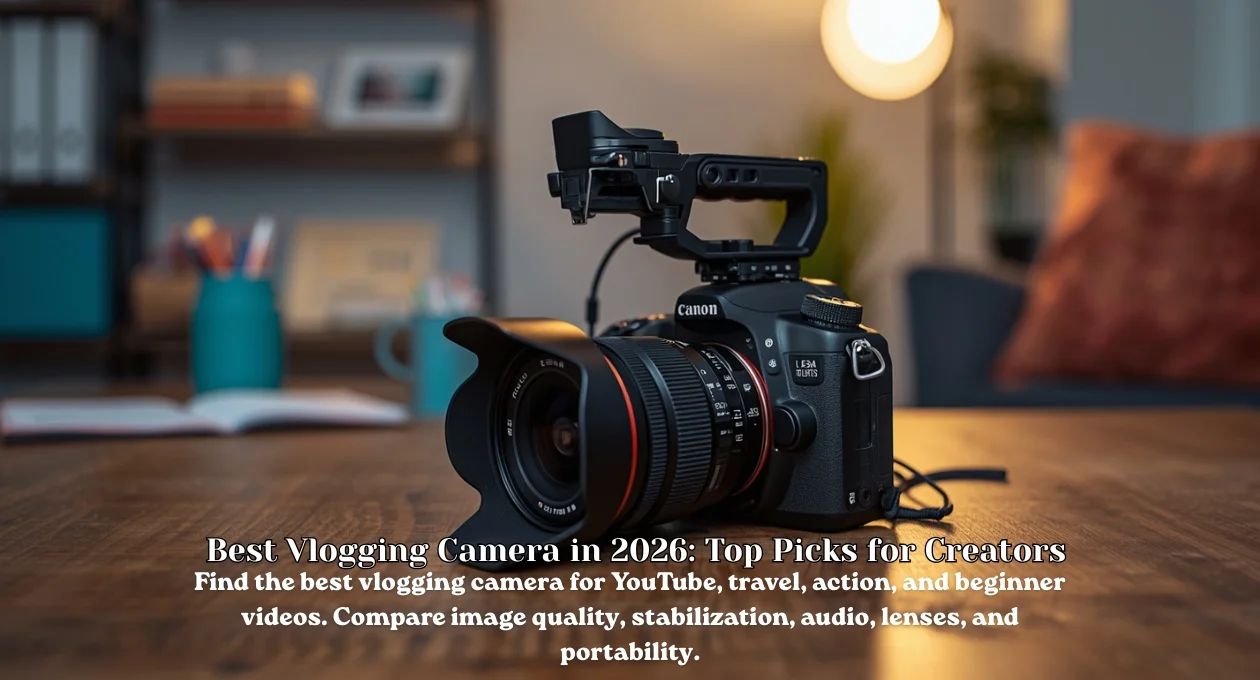
The best vlogging camera is not the one with the most megapixels or the longest zoom. It is the one that matches how and where you actually shoot. Most buyers get that wrong before they get it right. Some people buy a full-frame body built for cinema work and never leave a bedroom setup.
Others buy a tiny pocket gimbal camera then wonder why it cannot keep up with a fast-moving travel vlog. This roundup sorts the strongest options by real use case instead of ranking specs on a chart so you can land on a camera for vlogging that fits your actual routine and skip the ones that only look good on paper.
And it’s worth zooming out for a second. The Tek Zio covers a lot of ground beyond cameras from smart home devices and wearable technology to smartphones smartwatches wireless earbuds and AI-powered gadgets.
fVlogging cameras sit inside a wider wave of consumer tech that includes foldable phones portable tech IoT devices robot vacuums AR/VR gadgets smart speakers and fitness trackers along with trending themes like AI PCs and AI laptops battery technology 5G gadgets sustainable tech CES innovations edge AI devices health-monitoring wearables smart rings portable speakers and mini PCs.
If you already follow tech reviews product launches technology trends hardware innovations and gadget reviews in general a vlogging camera purchase is one small piece of a much bigger faster-moving picture. It deserves the same level of scrutiny you’d give any other electronics purchase.
Quick Answer: For most content creators the DJI Osmo Pocket 3 is the best vlogging camera for travel and on-the-move shooting thanks to its 1-inch sensor and 3-axis gimbal. The Sony ZV-E10 II is the top mirrorless camera for vlogging overall. The Canon PowerShot V1 is the best compact hybrid for stills and video. Budget shoppers under $500 should look at the GoPro Hero 13 Black or a fixed-lens compact while action and adventure vloggers should compare the GoPro Hero 13 Black against the Insta360 X5.
What Actually Makes a Camera Good for Vlogging
A good vlogging camera answers three questions well. Can you see yourself while filming? Can the camera keep you in focus while you move? Can it record clean audio without extra gear strapped on? A flip screen or fully articulated screen handles the first question. Every camera on this list has some form of articulating or flip screen and that alone rules out a large chunk of older mirrorless bodies built with photography in mind rather than solo talking-head video.
Autofocus and eye tracking answer the second question. Older compact cameras used contrast-detection autofocus which tends to hunt back and forth when a face moves in and out of frame. Not fun to watch. Newer sensors use phase-detection subject tracking that locks onto a face the moment it appears and holds focus through most walk-and-talk footage. Stabilization whether it comes from a mechanical gimbal optical stabilization or digital image stabilization like GoPro’s HyperSmooth answers the last piece: whether your B-roll looks handheld and shaky or looks like it came off a small rig.

Best Pocket and Travel Vlogging Camera: DJI Osmo Pocket 3
The DJI Osmo Pocket 3 is the easiest camera for vlogging on the move because it solves stabilization and portability at the same time. As the Osmo Pocket 3 vlogging camera it uses a 1-inch CMOS sensor mounted on a mechanical 3-axis gimbal and DJI’s own spec page lists support for 4K video at up to 120fps (4K at 60 frames per second in standard mode) a 2-inch rotatable touch screen and full-pixel fast autofocus.
DJI a brand better known among some shoppers for the best drone lineups on the market applies much of the same gimbal engineering here. That sensor size is a meaningful jump over the 1/1.7-inch sensor in the older Osmo Pocket 2 and DJI’s ActiveTrack 6.0 subject tracking keeps a walking or running subject in frame without a second operator.
The base Osmo Pocket 3 kit runs close to $519. The Creator Combo which adds a wireless mic and a wide-angle lens attachment lands closer to $669. Worth knowing: it is not a rugged action cam. There is no waterproofing on the standard body so if your travel vlogging plans include rain snow or water sports pair it with a case or look at the action camera picks further down. But for a solo creator who wants pocketable and handheld video without carrying a separate gimbal this is still one of the better picks for 2026.
DJI’s Osmo Action 6 covers similar ground for rugged waterproof shooting if you need that instead of the Pocket 3’s gimbal-first design. And the newer DJI Osmo Pocket 4 has started to appear in some buying roundups as the current flagship in the Pocket line so it’s worth a quick spec check against the Pocket 3 before you buy.
Best Mirrorless Vlogging Camera: Sony ZV-E10 II
The Sony ZV-E10 II is built around a 26-megapixel APS-C sensor and Sony’s BIONZ XR processor. It launched at $999 body-only or $1099 with the kit lens according to Sony’s announcement covered by Notebookcheck. It has 759 autofocus points with real-time eye tracking for people and animals and it can shoot 4K video at up to 60 frames per second with 10-bit color depth for more flexibility if you plan to color grade your vlogs afterward.
Here’s something worth knowing: because this is an interchangeable-lens camera it grows with you the way a fixed-lens compact cannot. You can start with the kit zoom and add a wide-angle prime later for tighter indoor vlogging spaces or a longer lens for outdoor B-roll. The trade-off? It lacks in-body image stabilization and a mechanical shutter so fast-moving subjects can show rolling shutter artifacts and you’re relying on lens-based or digital stabilization rather than a gimbal.
For a stationary desk setup a podcast-style talking-head channel or a creator who already owns E-mount lenses from an older Sony ZV-E10 or a6000-series body this is an excellent camera that’s more likely to hold up for years rather than months without forcing you to buy a whole new camera every time your channel outgrows larger cameras built purely for stills photography.
The Sony ZV-1 II and the full-frame ZV-E1 sit at opposite ends of the same lineup. The ZV-1 II is a cheaper fixed-lens vlog camera and the ZV-E1 is a pricier best full-frame vlogging camera pick for creators who need the most low-light headroom the ZV series offers. If you want a hybrid alternative outside the Sony ecosystem the Fujifilm X-S20 and the smaller Fujifilm X-M5 cover similar ground with in-body stabilization and Fujifilm’s film-simulation color profiles built in.
Best Hybrid Compact: Canon PowerShot V1
Canon’s PowerShot V1 pairs a 1.4-inch CMOS sensor noticeably larger than the 1-inch sensors used in most compacts with a fixed 16-50mm equivalent zoom lens and a built-in 3-stop ND filter. According to Canon’s official product page it shoots 4K video at up to 60fps with a slight sensor crop supports C-Log 3 for more control in post-production and captures 22.3-megapixel stills. That combination is what makes it a real hybrid stills and video camera for creators who also want sharp photos.
US pricing launched around $899.99 and has since drifted up toward $979 on some retail listings. That puts it above the GoPro Hero 13 Black and the DJI Osmo Pocket 3 but below the Sony ZV-E10 II with a lens attached. Canon’s smaller PowerShot V10 remains available as a cheaper more pocketable option with a built-in kickstand aimed more squarely at beginners who want vertical-ready video for TikTok and Instagram Reels without the zoom range of the V1.
Best Budget Vlogging Camera Under $500
If your budget caps out under $500 your realistic choices are a fixed-lens action camera or a smaller compact rather than a full mirrorless body. Here’s how the top entry-level camera options compare on paper.
| Camera | Sensor | Max Video | Screen | Approx. Price |
|---|---|---|---|---|
| GoPro Hero 13 Black | 1/1.9-inch | 5.3K/60fps 4K/120fps | 2.27-inch rear touch | ~$329 |
| DJI Osmo Pocket 3 (Standard) | 1-inch CMOS | 4K/120fps | 2-inch rotatable touch | ~$519 |
| Canon PowerShot V10 | 1-inch stacked CMOS | 4K/30fps | 2-inch flip | ~$379 to $430 |
The GoPro Hero 13 Black is the clearest budget vlogging camera pick if you want one small camera that also survives drops dust and light rain. It is not waterproof without a housing at greater depths but it handles everyday outdoor use without extra protection. It uses digital stabilization rather than a mechanical gimbal so footage is smooth just not quite as steady as gimbal-based options like the Osmo Pocket 3.
Best Action Camera: GoPro Hero 13 Black vs. Insta360 X5
Action cameras solve a different problem than pocket gimbals or mirrorless bodies. They need to survive being worn mounted or dropped and they need to shoot wide-angle footage without a rig. The two leading action cam options in 2026 take different approaches to the same goal.
| GoPro Hero 13 Black | Insta360 X5 | |
|---|---|---|
| Sensor | 1/1.9-inch | Dual 1/1.28-inch |
| Capture style | Single-lens fixed wide angle | 360-degree reframe later |
| Waterproof depth | 33 feet (10m) without a case | 49 feet (15m) |
| Starting price | ~$329 | ~$549 to $559 |
| Best for | Straightforward action cam use quick edits | Reframing shots after filming adventure vlogging |
Camera experts at outlets like Amateur Photographer in a side-by-side comparison note that the GoPro Hero 13 Black is the cheaper and simpler option if you know your shot before you press record. The Insta360 X5’s 360 camera design does something different: it captures everything around you and lets you pick the angle afterward.
That’s genuinely useful for adventure vlogging where you cannot always predict the best framing in the moment. And if a full action cam body is more than you need the Insta360 GO Ultra and GO 3S models push the same POV camera idea into a magnetic clip-on form factor delivering smooth footage even without a mechanical gimbal.

How to Build a Complete Vlogging Setup
A camera alone rarely produces a finished vlog. Here’s a practical order for building out a full vlogging setup without overspending on gear you won’t use.
- Pick your camera body first based on the use case sections above before you shop for accessories.
- Add a wireless microphone. A DJI Mic Mini or a comparable wireless mic solves the single biggest audio problem in vlogging: a subject’s voice becoming quiet and echo-heavy the moment they step away from an in-camera or built-in microphone. The DJI Mic Mini’s base kit runs close to $89 with a two-transmitter kit closer to $169.
- Get a lightweight tripod or a small gimbal depending on whether your camera already has built-in stabilization.
- Buy one extra battery. Battery life on compact vlogging cameras rarely covers a full day of shooting and swapping a spare takes seconds compared to hunting for an outlet.
- Add an ND filter only if you shoot outdoors often. Several cameras on this list including the Canon PowerShot V1 already include one built in.
- Set your video format once then leave it alone. Shooting in 10-bit or D-Log gives more room to color grade later but it also creates flatter lower-contrast footage straight out of camera. Only use it if you actually plan to edit.
If you’re building a desk-based setup rather than a handheld one a budget monitor built for photo editing can make color grading and thumbnail work a lot easier than editing on a laptop screen alone.
Beginner Mistakes When Choosing a Vlogging Camera
- Buying by megapixel count instead of sensor size. A 12-megapixel full-frame sensor will usually outperform a 48-megapixel smartphone sensor in low light because the individual pixels are physically larger and gather more light.
- Skipping the flip screen. Without one you can’t confirm framing focus or exposure while filming yourself and you’ll find out about a ruined shot only after the fact.
- Ignoring autofocus specs. A camera with weak subject tracking will hunt for focus constantly during talking-head videos. That’s one of the fastest ways to lose a viewer in the first ten seconds.
- Assuming the built-in microphone is good enough. Even a great camera with excellent image quality will read as low-budget if the audio is thin echoey or picks up wind noise.
- Overbuying zoom range you won’t use. Most solo vloggers frame themselves at a fixed close distance which makes long zoom ranges mostly irrelevant.
- Not checking battery life against your real shoot length. A camera rated for 90 minutes of continuous 4K recording may deliver a lot less in a hot car or under direct sun.
- Choosing a bulky mirrorless body for casual spontaneous content. If you want to start vlogging on short notice a small camera you’ll actually carry beats a larger more capable one left at home.
Specs and Standards That Actually Matter
Vlogging cameras lean on a handful of formal standards that most buying roundups skip over and they directly affect whether your footage records cleanly.
- SD Association UHS Speed Class. According to the SD Association’s own speed class documentation a UHS-II card rated U3 or higher is generally the practical minimum for 4K video at 60 frames per second without dropped frames. Cameras shooting 4K at 120fps benefit from an even faster card.
- USB-IF USB-C Power Delivery. Fast-charging claims from DJI Sony and Canon are built on the USB Power Delivery specification maintained by the USB Implementers Forum which governs how much wattage a camera or mic can safely pull from a charger.
- Wi-Fi Alliance wireless standards. The Wi-Fi 5 and Wi-Fi 6 certifications from the Wi-Fi Alliance govern how quickly you can transfer 4K video files from camera to phone. That matters if you’re editing and posting from a phone rather than a laptop.
Vlogging Camera Stats and Data
| Data Point | Year | Source | Why It Matters |
|---|---|---|---|
| DJI Osmo Pocket 3: 1-inch CMOS sensor up to 4K/120fps | 2023 launch current in 2026 lineups | DJI official spec page | Sensor size is the single biggest lever on image quality in this category |
| Sony ZV-E10 II: 26MP APS-C sensor 759-point autofocus $999 body-only | 2024 launch price | Sony via Notebookcheck | Anchors the price of a serious interchangeable-lens hybrid |
| Canon PowerShot V1: 22.3MP 1.4-inch sensor built-in 3-stop ND filter | 2025 launch | Canon USA product page | Largest sensor in a fixed-lens vlogging compact as of publish |
| GoPro Hero 13 Black starting price | 2026 retail pricing | Manufacturer and retail listings | Sets the entry-level action camera price floor |
| DJI Mic Mini: about $89 for one transmitter about $169 for a two-transmitter kit | 2024 launch current in 2026 | DJI official store | Shows that reliable wireless audio no longer requires a large separate budget |
Reality Check: Will You Actually Notice the Difference
Jumping from a smartphone camera to almost any dedicated camera on this list produces a difference most viewers will notice immediately mainly in low light and background blur. Jumping from a $1000 mirrorless camera to a $2000 one though mostly changes things a casual viewer will never spot on a phone screen: marginally cleaner shadows slightly better dynamic range and autofocus that’s a touch more reliable in tricky light.
If your channel lives on YouTube Shorts TikTok or Instagram Reels where most people watch compressed video on a five-inch screen a mid-tier camera paired with good audio and steady lighting will look close to indistinguishable from a far pricier setup to most of your audience.
Sensor size and bit depth explain why. A larger sensor gathers more light per pixel and that’s what actually produces that smoother less noisy look in dim rooms not the megapixel count on the box. Beyond a certain sensor size most of what you’re paying for is autofocus reliability build quality and lens options rather than a visible jump in everyday image quality.
Who Should Buy Which Camera
Match the camera to how you shoot not to what looks most impressive on a spec sheet.
- Budget buyer: GoPro Hero 13 Black or a sub-$500 fixed-lens compact. You get a solid camera for casual content without committing to a full kit.
- Travel and on-the-move creator: DJI Osmo Pocket 3. Gimbal stabilization and a pocketable body beat a heavier mirrorless setup when you’re moving through airports streets or trails all day.
- Long-term content creator building a channel: Sony ZV-E10 II. Interchangeable lenses give you an upgrade path a fixed-lens camera cannot match.
- Hybrid stills and video shooter: Canon PowerShot V1. You get sharp photos and 4K60 video from one body without carrying two devices.
- Adventure or underwater vlogger: Insta360 X5 if you want to reframe footage after the fact or the GoPro Hero 13 Black if you’d rather nail the shot live and skip extra editing steps.
- Complete beginner unsure they’ll stick with it: Start with your smartphone and an $89 wireless mic. Upgrade to a dedicated camera once you know what you’re actually filming week to week.
FAQ
What is the best vlogging camera for beginners?
For most people just getting started a smartphone paired with a clip-on wireless mic and a small tripod covers the basics without any upfront camera cost. Once you know your format the GoPro Hero 13 Black or the Canon PowerShot V10 are strong first dedicated cameras because both are simple to operate and forgiving of shooting mistakes.
Is a DSLR or mirrorless camera better for vlogging?
Mirrorless cameras are almost always the better pick for vlogging over a DSLR mainly because mirrorless bodies are lighter use quieter autofocus motors and more often include a flip or fully articulated screen built for filming yourself. Most camera manufacturers including Sony and Canon have shifted their vlogging-focused lineups entirely to mirrorless.
Do I need a separate microphone for vlogging?
A separate wireless microphone makes a bigger difference to how professional your vlogs sound than almost any camera upgrade. Built-in microphones pick up wind room echo and handling noise while a clip-on wireless mic like the DJI Mic Mini keeps your voice close and clear even outdoors.
What is the best vlogging camera under $500?
Under $500 the GoPro Hero 13 Black is the best all-around pick thanks to its combination of durability wide-angle lens and digital stabilization. A used or previous-generation compact camera can also work well if you’re comfortable buying secondhand gear.
Can I vlog with just my smartphone?
Yes. The best phone you already own can produce solid video for short-form platforms like TikTok and Instagram Reels and plenty of successful content creation starts on a smartphone camera alone. Where phones fall behind a dedicated camera is autofocus tracking during movement background blur and low-light image quality all of which become more noticeable as your audience and production quality grow.
What is the best camera for YouTube vlogging specifically?
For long-form YouTube vlogging the Sony ZV-E10 II is a strong default choice because of its autofocus reliability 10-bit color for editing flexibility and room to add lenses as your channel grows. Creators focused on travel-style YouTube content often prefer the DJI Osmo Pocket 3 instead for its gimbal stabilization while walking.
Is the DJI Osmo Pocket 3 or Sony ZV-E10 II better?
Neither wins in every situation. The Osmo Pocket 3 wins for portability and built-in stabilization making it better for on-the-move and travel vlogging while the Sony ZV-E10 II wins for image quality lens flexibility and long-term upgrade potential in a stationary or semi-stationary setup.
What sensor size do I need for good low-light vlogging?
A 1-inch sensor like the one in the DJI Osmo Pocket 3 is a reasonable minimum for consistently usable low-light footage. APS-C sensors like the one in the Sony ZV-E10 II and larger sensors like the 1.4-inch chip in the Canon PowerShot V1 perform noticeably better once natural light drops.
Do vlogging cameras need 4K video?
Most vlogging cameras released in 2026 shoot 4K as a standard feature rather than a premium one so it’s rarely a deciding factor on its own. The bigger practical benefit of 4K is the ability to publish in 1080p while still having room to crop and reframe shots during editing.
What is the best compact vlogging camera for travel?
For pure travel use the DJI Osmo Pocket 3 remains the best small vlogging camera thanks to its combination of a 1-inch sensor mechanical gimbal and pocket-friendly size. The Canon PowerShot V1 is a close second if you want a built-in zoom lens instead of relying on digital zoom or a wide-angle attachment.
Ready to compare more picks in this cluster? If you’re chasing the highest-end gear on the market instead of a budget pick our look at the most expensive camera available shows what a truly no-limit budget buys. For a broader view of where compact and mirrorless video cameras are headed this year our Tech Accessories coverage tracks new releases as they land.
Editorial Standards
The Tek Zio does not run an in-house hardware lab and has not physically tested the cameras named in this article. Recommendations are built from manufacturer spec pages official product documentation standards body publications from groups like the SD Association and the USB Implementers Forum and reporting from established independent testing outlets. This article was last checked for pricing and spec accuracy on September 16 2026 and prices in particular can shift with retail sales cycles so confirm current pricing before you buy.


