
What Is Pharyvac Surgical Technology?
Start with the simplest idea: pharyvac surgical technology targets a messy, risky, and often underestimated part of ENT surgery. During sinonasal or skull-base procedures, blood, smoke, debris, and irrigating fluid can collect near the throat and airway. Traditional suction helps, yet it can interrupt the surgeon’s rhythm. This emerging intrapharynx aspiration catheter aims to keep the field clearer through continuous evacuation, giving the surgical team a steadier view when precision matters most and every millimeter counts.
Unlike a flashy robot or screen-heavy platform, this technology focuses on a quieter problem inside the operating room. It combines airway aspiration, posterior nasal cavity placement, and workflow support into a single-use device concept. Mount Sinai describes Pharyvac as a sterile cuffed catheter designed to evacuate blood, smoke, and biological debris while also supporting irrigation. For The Tek Zio, that makes it practical medtech: less spectacle, more surgical usefulness.
Why ENT Surgery Needs Smarter Aspiration
Picture a windshield during heavy rain; even an expert driver needs clear glass. Surgeons face a similar challenge when blood or debris blocks the endoscope. In endonasal surgery, tiny visual interruptions can slow decisions and force extra suction passes. Pharyvac surgical technology tries to reduce that stop-start pattern by managing fluid and particles near the throat before they become a bigger nuisance. That’s not glamorous. It’s important, because clean visualization keeps delicate anatomy from turning into guesswork.
However, the issue goes beyond visibility. Surgical staff may face aerosol exposure, patients may swallow blood, and teams may rely on throat packs with their own drawbacks. The public SBIR award record names three target problems: staff exposure, patient blood ingestion, and obstructed endoscopic visualization. By addressing these together, pharyvac surgical technology sits at the intersection of patient safety, clinician protection, and operating-room efficiency, which hospitals increasingly measure with hawk-like attention.
How the Device Works in the Operating Room
Think of pharyvac surgical technology as a specialized drain placed where surgical fluids tend to travel. Public descriptions identify it as a balloon aspiration catheter positioned around the posterior nasal cavity or intrapharynx. Once placed, it can support continuous suction rather than relying only on intermittent manual suction. The design aims to capture blood, smoke, debris, and stray fluid while the surgeon keeps both eyes on the operative field and both hands focused on fine movement.
Moreover, this technology may reduce clutter around the endoscope. Instead of juggling throat packs and separate suction tubes, the device concept consolidates aspiration into a more ergonomic setup. That matters in endoscopic procedures, where instruments share a narrow corridor. A simpler tool path can save seconds repeatedly, and surgery often rewards those tiny savings. In a long case, small reductions in friction can feel like a door finally swinging open for the whole team.
Key Benefits for Surgical Teams and Patients
Here’s where pharyvac surgical technology becomes especially interesting for hospitals and surgical innovators. A clearer view can support faster decisions, cleaner maneuvers, and fewer pauses for manual suction. Teams may also reduce the need to pack the throat with absorbent material. When a device helps visibility and housekeeping at the same time, it earns attention from surgeons who value tools that do their job without shouting for attention or demanding a new operating-room ritual.

For patients, the potential value centers on blood ingestion reduction, less postoperative nausea risk, and better airway cleanliness during selected ENT procedures. These benefits need careful clinical validation, of course. Early-stage devices don’t deserve miracle language. Still, this technology reflects a patient-centered design instinct: solve a simple physical problem before it creates discomfort, delay, or risk. That’s medtech at its most sensible, like fixing the drain before remodeling the entire kitchen.
Pharyvac Surgical Technology vs Traditional Throat Packs
Traditional throat packs can help catch blood and debris, yet they add another task to the surgical checklist. Teams must place them properly, monitor them, and remove them reliably. In some cases, packs can also contribute to irritation or complications. Pharyvac surgical technology proposes a different route by using active aspiration rather than passive absorption. The contrast feels like using a sump pump instead of a towel when the basement starts taking on water.
| Feature | Traditional Throat Pack | Pharyvac Concept |
| Main action | Absorbs blood and fluid after contact | Actively evacuates material through suction |
| Workflow impact | Requires placement, monitoring, and removal | Aims to reduce manual suction interruptions |
| Visibility support | Indirect, because it catches migrating fluid | Directer, because it targets continuous evacuation |
| Safety focus | Helps limit swallowed blood | Adds focus on exposure, blood migration, and debris |
| Best-fit discussion | Familiar, low-tech, widely understood | Emerging, evidence-driven, and still moving through validation |
That analogy isn’t perfect, yet it explains the workflow shift. A towel fills up; a pump keeps moving fluid away. Similarly, pharyvac surgical technology aims for continuous evacuation while reducing dependence on extra suction maneuvers. If clinical evidence supports the concept, the device could become attractive in sinonasal surgery, endoscopic skull-base surgery, and other procedures where visualization, airway cleanliness, and team protection all converge. The best tools often win by removing repetitive irritation.
The Mount Sinai BioDesign Origin Story
Every useful device begins with a stubborn problem. Pharyvac surgical technology grew from Mount Sinai BioDesign work during the COVID-19 era, when rhinology and endonasal surgery faced new scrutiny around aerosols and workflow. The project came from a clinician-engineer environment, with Alfred Marc Iloreta, MD, and Turner S. Baker, PhD, connected to early development. That origin gives the device a credible needs-first foundation rather than a gadget-first story with shiny marketing varnish.
In plain terms, this technology appears to follow the best medtech playbook: observe surgery, identify repeated friction, prototype, test, and iterate. Duke University also highlighted engineering involvement through Megan Christy’s work on aspiration-device development. This matters because operating-room products live or die by details: cuff shape, suction behavior, placement comfort, tubing position, and setup speed. Tiny design flaws can annoy teams; elegant ones disappear into the workflow like good stagehands.
Research, Funding, and Regulatory Status
Follow the money and the milestones, not the hype. Pharyvac surgical technology received a 2024 NIH STTR Phase I award through SBIR records, with public funding listed for development of a kit to reduce aerosolized particles during endonasal surgeries. The award summary mentions bio-realistic model testing, large-animal feasibility work, and a later Phase II path involving FDA engagement and first-in-human trials. That’s a serious but still developmental pathway, not a finished victory lap.

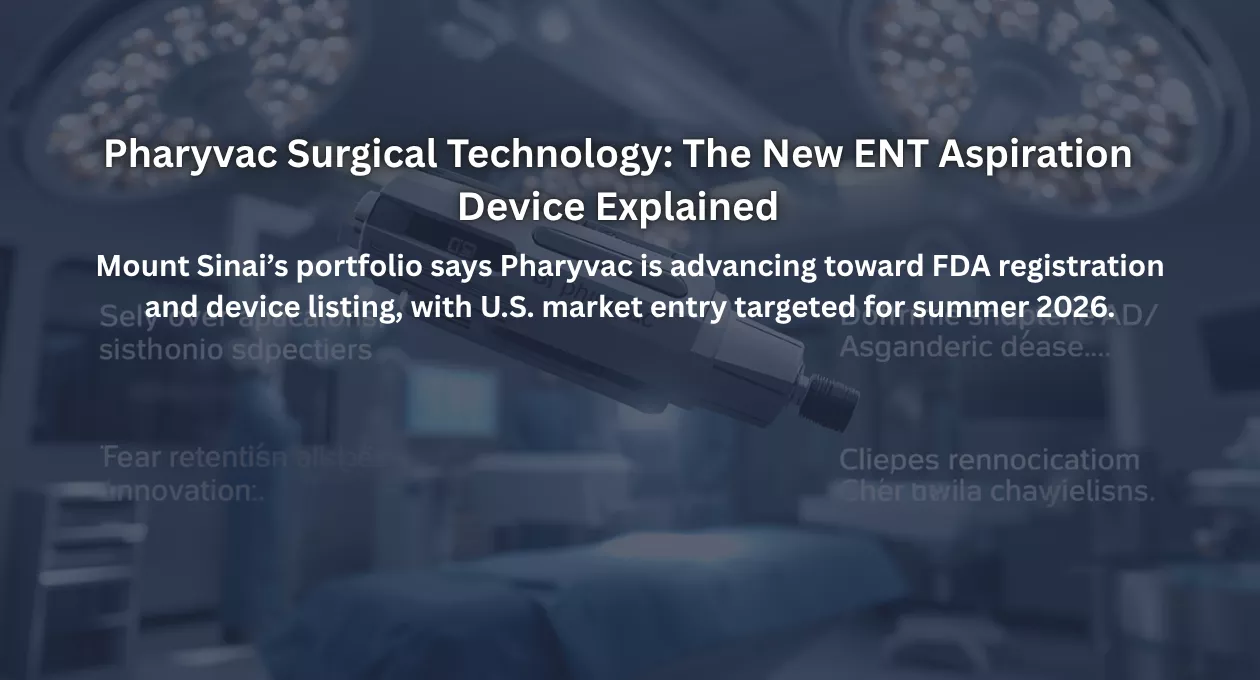
Meanwhile, Mount Sinai’s portfolio says Pharyvac is advancing toward FDA registration and device listing, with U.S. market entry targeted for summer 2026. Another Mount Sinai report described human trials in France around late 2025. Readers should treat this technology as emerging medical technology, not as a universally available standard device. Regulatory pathways, clinical evidence, and hospital purchasing decisions will shape its real-world adoption; hype alone won’t get it through the hospital door.
Where It Fits in the Future of Surgery
Surgery’s next chapter won’t belong only to robots, AI, or augmented-reality headsets. Many advances will come from humble devices that remove one nagging obstacle. Pharyvac surgical technology fits that pattern because it targets surgical visibility, fluid control, and exposure reduction at once. It’s not trying to replace the surgeon. Instead, it may help the surgeon work with fewer interruptions and a cleaner anatomical canvas, which can matter more than flashy dashboards.
Additionally, this technology aligns with a broader push toward minimally invasive surgery, smarter suction, and more disciplined operating-room ergonomics. As robotics and imaging improve, fluid management must keep pace. A crystal-clear 4K endoscope loses value when blood clouds the view. That’s why aspiration innovation matters. It supports the entire surgical stack, from human judgment to digital visualization, like good plumbing underneath a beautiful building. Nobody applauds it, yet everyone needs it.
What Hospitals Should Watch Before Adoption
Before any hospital gets excited, procurement teams should ask practical questions. Does pharyvac surgical technology integrate with existing suction systems? How quickly can staff learn placement? Does it reduce total case time? How does it affect disposable-device cost? And most importantly, what do clinical data show across different surgeons, case types, and patient anatomies? Good technology proves itself under ordinary pressure, not only in polished demonstrations with immaculate lighting and rehearsed talking points.
Still, early indicators make pharyvac surgical technology worth watching. It targets a frequent procedural pain point, comes from a surgeon-led innovation ecosystem, and addresses safety themes that hospitals already care about. The Tek Zio readers should view it as a case study in smart problem selection. Great medtech doesn’t always start with a moonshot. Sometimes it starts with one annoying, bloody, visibility-stealing problem that finally gets a better answer and a cleaner workflow.
For more amazing blogs keep visiting The Tek Zio.


