
Before buying any older camera, the smartest move is separating useful technology from dusty nostalgia. This guide looks at real specifications, practical shooting behavior, lens choices, and used-camera buying sense so you can decide without marketing fog. The camera market moves fast, but good sensors, stable ergonomics, and thoughtful controls don’t suddenly expire. For readers of The Tek Zio, that’s the fun part: great tech often hides in plain sight, waiting for someone patient enough to use it well.
Why the sony a7ii Still Matters in 2026
The sony a7ii earns attention because it gives photographers a serious full-frame mirrorless camera without the wallet-whacking price of newer bodies. It launched as a compact E-mount model with a 24.3MP 35mm full-frame Exmor CMOS sensor, Wi-Fi with NFC, ISO 50–25600, and up to 5 fps continuous shooting, which still covers portraits, travel, products, and everyday storytelling with admirable calm. (Sony Indonesia) That mix keeps it relevant for learners who want depth instead of disposable specs. It’s old, not obsolete.
However, its real charm comes from balance, not bragging rights. You don’t buy this camera to chase 8K clips or bird-eye autofocus; you buy it for image quality, manual control, full-frame depth, and affordable camera gear that teaches craft. For a technology reader visiting The Tek Zio, that matters because older tech can still deliver fresh results when the fundamentals stay strong. Think of it like a well-tuned bicycle: not flashy, yet wonderfully honest. Good tools age with dignity.
Design and Handling That Feel Grown-Up
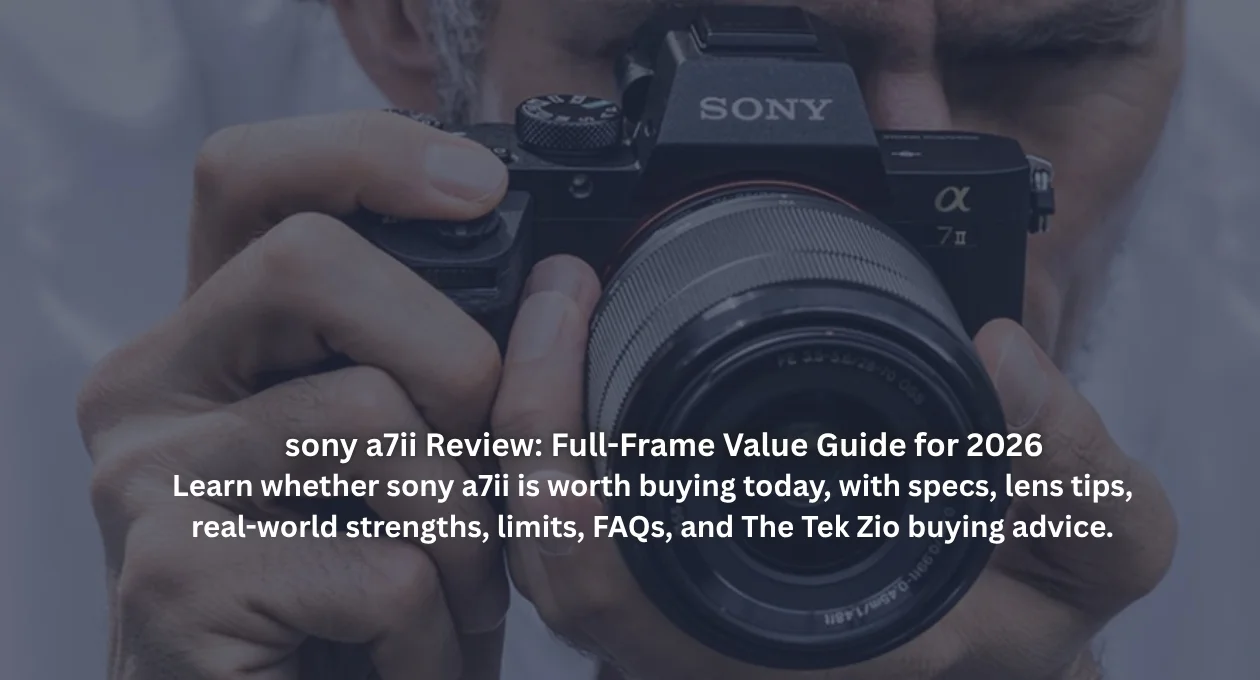
With sony a7ii, Sony moved beyond the slightly angular first-generation body and gave shooters a deeper grip, sturdier feel, and more confident button layout. The official body dimensions sit at 126.9 x 95.7 x 59.7mm, with weight listed at 599g including battery and media, so it feels compact beside many DSLRs while still offering a proper electronic viewfinder, tilting LCD, weather-conscious build, and E-mount system practicality. (Sony Indonesia) The grip helps during longer handheld sessions.
Moreover, the controls reward slow, deliberate shooting. The exposure dials encourage you to think before pressing the shutter, while the 0.5-inch EVF with 2,359,296 dots gives a clear preview for framing and exposure judgment. (Sony Indonesia) That’s handy for beginners because what you see usually resembles what you get. No crystal ball required; just a camera that speaks plainly through its viewfinder clarity, custom buttons, and photography workflow. After a week, muscle memory starts doing quiet magic.
Image Quality from a 24.3MP Full-Frame Sensor
Inside the sony a7ii sits a 35.8 x 23.9mm Exmor CMOS sensor with 24.3 effective megapixels, RAW plus JPEG modes, 14-bit RAW output, and a 6000 x 4000 maximum 3:2 still-image size. (Sony Indonesia) Those numbers may look modest in an age of 60MP monsters, yet they provide a sweet spot for dynamic range, portrait photography, landscape shots, and print-ready detail without burying your laptop under elephant-sized files. Storage stays manageable too.
For example, a 24MP full-frame file gives enough room to crop a portrait, clean up a product photo, or print a family image for the wall. However, exposure discipline still matters. Lift deep shadows too aggressively and older sensor noise can peep through like a nosy neighbor. Use good light, steady technique, and sharp glass, and the camera rewards you with natural colors, soft background blur, RAW editing flexibility, and low-light photography confidence. It’s forgiving, not foolish-proof.
Stabilization: The Feature That Changed the Conversation
The sony a7ii brought 5-axis image stabilization to a full-frame body, and Sony described it as the world’s first full-frame camera with that feature. (Sony Indonesia) This matters because in-body image stabilization helps with pitch, yaw, roll, and small hand movements when using many lenses. In plain English, it gives handheld shots a fighting chance when the light dips or coffee hands appear. That’s a serious advantage for people who hate tripods. Street shooters will notice it quickly.
Additionally, Sony rates the stabilization compensation at 4.5 steps under CIPA conditions with a Sonnar T* FE 55mm F1.8 ZA lens. (Sony Indonesia) That doesn’t mean every shot magically turns sharp; moving subjects still blur if your shutter crawls. Yet for museums, street walks, food photos, and adapted manual lenses, the system feels like a pocket-sized tripod. It supports handheld shooting, vintage lenses, night photography, and travel photography beautifully. Use it wisely, and it becomes quiet insurance.
Autofocus and Speed in Real-World Shooting
The sony a7ii uses enhanced Fast Hybrid AF with 117 phase-detection points on full-frame and 25 contrast-detection points, according to Sony’s specifications. (Sony Indonesia) That setup works well for portraits, casual events, family moments, and general street scenes. It won’t behave like a modern sports body, but it can still nail focus when you use single-point AF, face detection, focus tracking, and good lenses intelligently. Technique matters more here than menu worship. Slow down slightly.

Nevertheless, expectations need a seatbelt. Five frames per second is fine for a child running through a park, not ideal for competitive football or nervous birds. The camera rewards anticipation more than machine-gun shooting. Pre-focus, choose a practical shutter speed, and keep your subject within the AF area. That simple discipline makes mirrorless autofocus, burst shooting, street photography, and event photography feel more dependable. Old-school timing still wins plenty of modern moments.
Video Quality and Creator Limits
The sony a7ii records video in AVCHD, MP4, and XAVC S, with XAVC S reaching up to 1920 x 1080/60p at 50Mbps. (Sony Indonesia) That’s enough for talking-head videos, YouTube B-roll, family clips, and learning composition. You also get microphone and headphone connections, which makes serious audio easier than on many beginner cameras. (Sony Indonesia) For creators, 1080p video, external microphone, manual exposure, and cinematic footage remain useful. Sound can make humble footage feel premium.
However, this isn’t the right pick for creators who need 4K, 10-bit color, high-frame-rate slow motion, or modern subject recognition. Think of it as a dependable notebook rather than a Hollywood workstation. It can teach framing, light, sound, and editing discipline without drowning you in menus. Pair it with a bright prime, record clean audio, and the video performance, creator camera, content creation, and budget filmmaking results can still look polished. Limits can sharpen taste.
Best Lens Choices for the sony a7ii
Pair the sony a7ii with lenses that match its 24MP sensor instead of chasing oversized glass for bragging rights. For everyday shooting, a compact 28-70mm or 28-60mm zoom keeps the kit friendly. For portraits, an 85mm prime creates flattering compression. Digital Camera World’s 2026 guide highlights options such as Sigma 28-70mm f/2.8 DG DN, Sony FE 28-60mm f/4-5.6, Tamron 17-28mm f/2.8, and Tamron 70-300mm as practical choices. (Digital Camera World) Pick by use case first.
Furthermore, budget-minded buyers should consider lens purpose before lens prestige. A 35mm prime suits street and family life; a 50mm prime teaches composition; a 20mm or 17-28mm option opens real estate, vlogging, and landscape work. The smarter move is building a small bag around your habits. That keeps Sony FE lenses, prime lens, zoom lens, and lens compatibility decisions sane rather than expensive theater. Great lenses should solve problems, not decorate shelves. Your wrists will thank you.
Battery, Storage, and Daily Workflow
Battery life deserves honest discussion because the NP-FW50 pack isn’t a marathon runner. Sony lists up to 350 still shots and around 60–65 minutes of actual movie recording depending on viewfinder or LCD use. (Sony Indonesia) Carry two or three batteries for weddings, trips, or long city walks. The camera supports SD, SDHC, and SDXC media with UHS-I compatibility, so practical memory cards, backup batteries, camera accessories, and file management matter. Preparation beats panic every time.
For travel, the sony a7ii feels best when you pack light: one charged spare battery, one fast SDXC card, a compact charger, a cleaning cloth, and two lenses. Create folders after every shoot, back up RAW files, and label sessions before memory turns into soup. A tidy workflow protects your work and saves time. That’s where photo backup, RAW files, editing software, and travel kit discipline pays off. Small routines prevent giant headaches later. Future you deserves kindness.
Who Should Buy the sony a7ii Today?
Buy the sony a7ii if you want a low-cost entry into full-frame photography, enjoy learning manual settings, and care more about still images than futuristic video features. It suits students, hobbyists, bloggers, product photographers, portrait beginners, and travelers who value quality over novelty. The camera also works nicely for people upgrading from phones because full-frame sensor, interchangeable lenses, shallow depth of field, and manual photography create a visible leap. The difference feels obvious, not theoretical. That makes learning addictive.

On the flip side, skip it if you shoot fast sports, demand 4K, need long battery life, or want the newest autofocus intelligence. Newer cameras feel easier, faster, and smarter. Still, easy doesn’t always mean better for learning. This body nudges you to understand aperture, shutter speed, ISO, and lens choice. In that sense, beginner full-frame, used camera buying, photography skills, and camera value all meet in one sensible place. Patience becomes part of the kit.
sony a7ii FAQs for Smart Buyers
FAQ 1: Is sony a7ii good for beginners?
Yes, if the beginner wants to learn real photography rather than rely only on automation; the menus take patience, but the payoff feels satisfying.
FAQ 2: Does it shoot 4K?
No, it tops out at Full HD 1080/60p in XAVC S.
FAQ 3: Is it good for portraits?
Absolutely, especially with an 85mm, 55mm, or 50mm FE lens. These choices support portrait lens, bokeh, skin tones, and full-frame look.
FAQ 4: Is sony a7ii worth buying used?
Yes, when the shutter count, sensor, ports, IBIS, and battery door look healthy; avoid battered bodies with vague seller details.
FAQ 5: What’s the biggest weakness?
Battery life and older autofocus show their age first. Even so, the camera remains a clever buy for patient creators who want used mirrorless camera, Sony Alpha, camera inspection, and budget photography value without chasing every shiny launch. Inspect before buying; joy dislikes nasty surprises.
Final verdict:
This camera makes the most sense for people who enjoy learning, editing, and improving their eye. It won’t babysit every frame, and that’s partly the point. A newer body can make photography easier, but this one makes the process more visible. Buy carefully, choose lenses thoughtfully, and keep expectations realistic. Then the results can look far more expensive than the kit itself. In a market obsessed with the next big thing, that feels quietly rebellious.


