
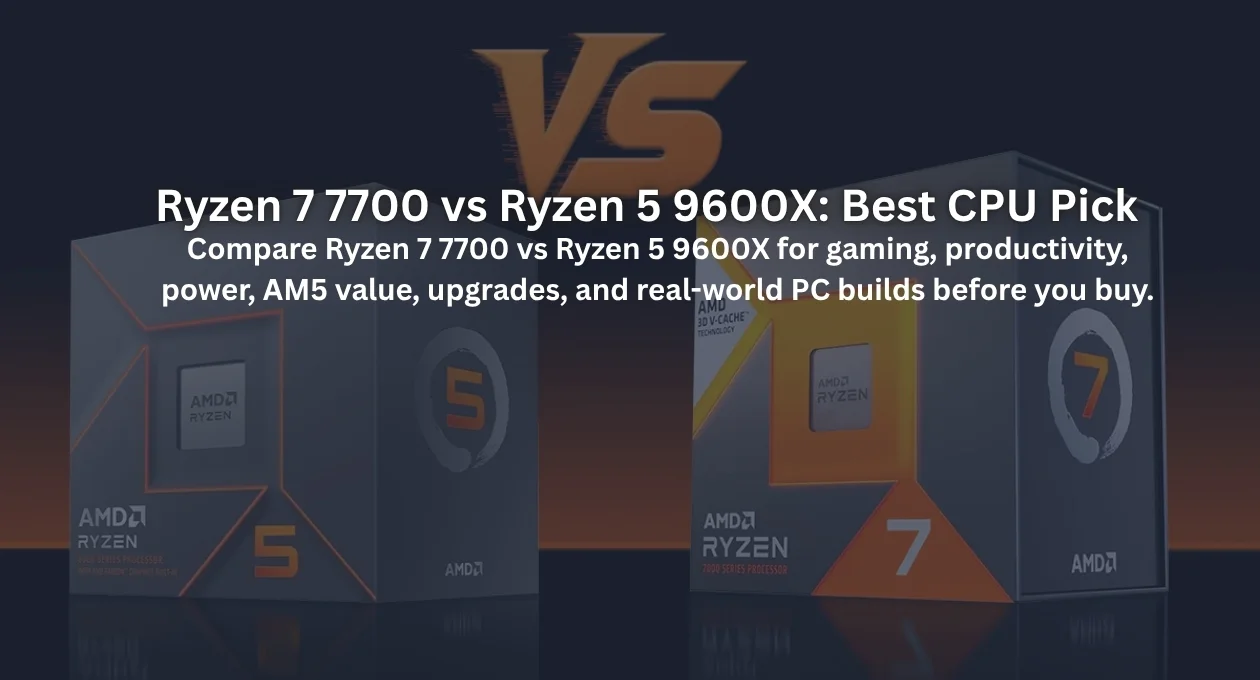
Ryzen 7 7700 vs Ryzen 5 9600X is a comparison between two AM5 processors with different strengths. The Ryzen 7 7700 has 8 cores and 16 threads, while the Ryzen 5 9600X has 6 cores and 12 threads with Zen 5 architecture. Both have a 65W default TDP and integrated Radeon graphics.
For buyers comparing these CPUs, the main questions are gaming performance, productivity, power, price, and upgrade value. This guide compares the Ryzen 7 7700 and Ryzen 5 9600X across those areas so you can choose based on your actual PC workload.
Ryzen 7 7700 vs Ryzen 5 9600X: Quick Comparison
Quick answer: Choose the Ryzen 7 7700 if you need more cores for streaming, video editing, rendering, heavy multitasking, or productivity. Choose the Ryzen 5 9600X if your priority is a newer Zen 5 architecture and strong gaming-focused performance. Both use the AM5 platform, support DDR5 memory, include integrated Radeon graphics, and have a 65W default TDP. The right choice mainly depends on whether you value 8 cores and 16 threads or the newer Zen 5 architecture.
Ryzen 7 7700 vs Ryzen 5 9600X Specs
| Feature | Ryzen 7 7700 | Ryzen 5 9600X |
| Architecture | Zen 4 | Zen 5 |
| Cores / Threads | 8 / 16 | 6 / 12 |
| Base / Boost Clock | 3.8 / 5.3 GHz | 3.9 / 5.4 GHz |
| L2 / L3 Cache | 8MB / 32MB | 6MB / 32MB |
| Default TDP | 65W | 65W |
| Socket | AM5 | AM5 |
A quick table can look like a scoreboard, yet real computers behave like kitchens during dinner rush. More cooks help when many dishes need work at once. Faster cooks help when one demanding recipe needs perfect timing. That is why Ryzen 7 7700 vs Ryzen 5 9600X should be judged through gaming, editing, cooling, price, and upgrade plans together. The smartest buyer looks past spec-sheet theater.
Zen 4 vs Zen 5: What’s Different?
Architecture is the hidden personality of a CPU. The Ryzen 7 7700 uses Zen 4, which remains fast, efficient, and mature. It has two extra cores compared with the Ryzen 5 9600X. That gives it an advantage when software spreads work across many threads. Think rendering, compiling code, running background tools, and keeping Discord, Chrome, OBS, and game launchers open together without turning your desktop into molasses.
The Ryzen 5 9600X uses Zen 5, and that matters in lightly threaded work. Many games and everyday apps still love strong per-core speed more than a pile of unused cores. In Ryzen 7 7700 vs Ryzen 5 9600X, the 9600X often feels crisp because it improves instruction handling and boosts a touch higher. It is like a smaller car with sharper steering, while the 7700 feels like a roomier cruiser. The Ryzen 5 9600X also supports modern instruction sets such as AVX2 and AVX-512. If software compatibility matters for your workload, read our Ryzen 5 9600X AVX2 support guide for a closer look.
Ryzen 7 7700 vs Ryzen 5 9600X Gaming Performance
Gaming makes the comparison spicy. In many titles, Ryzen 7 7700 vs Ryzen 5 9600X will feel close because the GPU usually carries the heavy load at 1440p and 4K. At 1080p with a powerful graphics card, the Ryzen 5 9600X can show its newer single-thread speed. Esports games, simulation titles, and high-refresh monitors may benefit from that quick response when every frame feels like a tiny victory.

Still, the Ryzen 7 7700 is no slouch. Its extra cores can help when you stream gameplay, record clips, keep voice chat open, or run browser tabs on a second monitor. Frame averages may not always jump, but 1% lows and system responsiveness can feel steadier in busy setups. For pure gaming, the 9600X is tempting. For gaming plus chaos, the 7700 has a sturdy spine and calmer manners.
Ryzen 7 7700 vs Ryzen 5 9600X Productivity Performance
Productivity changes the mood of Ryzen 7 7700 vs Ryzen 5 9600X. The Ryzen 7 7700 has more threads, so it handles parallel workloads with less strain. Video exports, large file compression, Blender scenes, multitasking, and software development often reward those extra cores. You may not notice it while opening a document, but you will notice it during long work sessions when several apps all want attention.
CPU performance can also change depending on the operating system and workload. If you are deciding which platform to use for development, compiling, rendering, or other CPU-heavy tasks, our Windows 11 vs Linux benchmark comparison explains the practical differences between both operating systems.
The Ryzen 5 9600X still performs very well for normal productivity. It opens apps quickly, handles spreadsheets smoothly, and works nicely for light creative tasks. However, six cores can feel tighter when several demanding jobs run together. If your PC is mainly a gaming and study machine, Ryzen 5 9600X works beautifully. If your PC earns money through content work, Ryzen 7 7700 looks wiser because time saved becomes money saved.
Power Consumption and Cooling
Both CPUs list a 65W TDP, which is good news for small cases, budget coolers, and quiet desks. In Ryzen 7 7700 vs Ryzen 5 9600X, neither chip demands a monster liquid cooler. A decent tower air cooler can keep either processor comfortable. That makes both options friendly for users who want a tidy build without turning their room into a tiny server closet during summer afternoons.
There is one practical difference that shoppers often miss. The Ryzen 5 9600X does not include a thermal solution in AMD’s boxed processor specification, so buyers should budget for a separate CPU cooler. For the Ryzen 7 7700, check the exact retail package and regional listing before purchase. If you need to buy a cooler separately, your total price changes. A cheap CPU can lose its sparkle when the cart grows teeth.
AM5 Motherboard and Upgrade Options
Platform value is where both chips smile. Ryzen 7 7700 vs Ryzen 5 9600X uses the same AM5 socket, so both support modern DDR5 systems and strong upgrade routes. A B650 motherboard can make sense for budget builds. X670 or X870 boards suit users who want more ports, stronger connectivity, and better expansion. You don’t need the fanciest board to enjoy either CPU, which keeps the build sensible.
Memory also matters. DDR5-6000 with EXPO remains a popular sweet spot for Ryzen gaming builds, though exact stability depends on the motherboard, BIOS, and memory kit. Since both CPUs sit on AM5, you can start with one chip and upgrade later. That keeps your motherboard, cooler, SSD, and RAM useful for longer. Good platform planning saves money quietly, like finding a discount hidden inside your future self.
Price and Value
Price can flip the whole verdict. If Ryzen 7 7700 vs Ryzen 5 9600X costs nearly the same in your market, the Ryzen 7 7700 becomes very attractive because extra cores age gracefully. It offers a broader comfort zone for work, streaming, and multitasking. For a family PC, creator setup, or long-term build, that flexibility matters more than one tiny benchmark win posted on a glossy chart.
However, if the Ryzen 5 9600X is much cheaper, it becomes the sharper gaming buy. You can put the savings toward a better GPU, larger SSD, stronger PSU, or nicer monitor. That upgrade may improve your actual experience more than two extra CPU cores. A balanced PC beats an unbalanced one every day. Don’t spend like a king on one part and then make the rest live on crumbs.
Ryzen 7 7700 vs Ryzen 5 9600X: Which One Fits Your Use?
Gamers who play competitive titles, use a dedicated GPU, and want a fresh AM5 build should strongly consider the Ryzen 5 9600X. In Ryzen 7 7700 vs Ryzen 5 9600X, it offers a lively feel for daily use and gaming. It is especially sensible when your workload stays light. Pair it with a good GPU and fast DDR5; you will have a clean, modern machine that feels quick without fuss.

Creators, streamers, students with heavy workloads, and professionals should lean toward the Ryzen 7 7700. The extra cores act like spare lanes on a busy highway. You may not need them every hour, but they matter when traffic gets ugly. Before checkout, compare live price, cooler inclusion, and BIOS support. Ryzen 7 7700 vs Ryzen 5 9600X has no single universal winner. Your workload gets the final vote.
FAQs
Ryzen 7 7700 vs Ryzen 5 9600X creates confusion because both processors are efficient, modern, and useful for different buyers. The decision gets easier when you focus on what you actually do every day. Gaming, editing, streaming, studying, office work, and future upgrades all pull the answer in slightly different directions. That is why a simple “better CPU” answer can mislead a buyer with a very different routine.
These FAQs answer the practical questions people ask before spending money. Instead of chasing one dramatic winner, compare your budget, software, and graphics card. Also check local availability because CPU pricing can change quickly. A great deal in one country may look ordinary in another. Smart buying starts with your own cart, not someone else’s benchmark chart. That little habit saves regret later.
Is Ryzen 7 7700 better than Ryzen 5 9600X?
Ryzen 7 7700 is better for multitasking, streaming, rendering, and heavier creative work because it has 8 cores and 16 threads. Ryzen 5 9600X is better for users who want newer Zen 5 architecture and strong gaming-focused responsiveness. For general gaming, the 9600X can be the smarter pick. For mixed workloads, the 7700 feels safer and more flexible because extra cores create comfort when your PC gets busy.
Is Ryzen 5 9600X good for gaming?
Yes, Ryzen 5 9600X is a strong gaming CPU for modern AM5 builds. It has fast boost clocks, strong single-core performance, and enough threads for most games. Pair it with a good GPU, fast DDR5 memory, and updated BIOS settings. It works especially well for 1080p high-refresh gaming and 1440p builds where the graphics card handles most of the load. It is small, sharp, and ready.
Should creators choose Ryzen 7 7700 instead?
Creators should usually choose Ryzen 7 7700 when the price difference is reasonable. Extra cores help with video editing, exporting, multitasking, and background workloads. The chip also stays efficient, which keeps noise and heat manageable. Ryzen 5 9600X can handle light creative tasks, but the Ryzen 7 7700 gives you more room when projects grow larger or deadlines get messy. Nobody enjoys watching an export crawl at midnight.
Do both CPUs need a graphics card?
Both CPUs include basic integrated Radeon graphics, so you can boot the PC, troubleshoot display issues, and handle simple desktop work without a dedicated GPU. However, serious gaming still needs a proper graphics card. The integrated graphics are not built for demanding games. Treat them like a spare tire. Useful in a pinch, but not something you use for a long road trip with heavy luggage.
Which CPU is better for future upgrades?
Both CPUs use AM5, so future upgrade potential depends more on your motherboard, BIOS support, and power delivery than the chip itself. Ryzen 5 9600X starts newer with Zen 5, while Ryzen 7 7700 starts with more cores. If you plan to upgrade later, buy a solid B650, X670, or X870 board. That gives your future CPU a better home and protects more of your build budget.
For More Information Keep visiting Thetekzio.


