Most people who set up a link hub make the same mistake. They paste eight URLs into one place, share it once and then wonder why nothing happens. The links work. Nobody clicks them. Nurture Tech Tips EmbedTree exists to fix exactly that problem, and it does it by treating your content as a growing structure rather than a flat list.
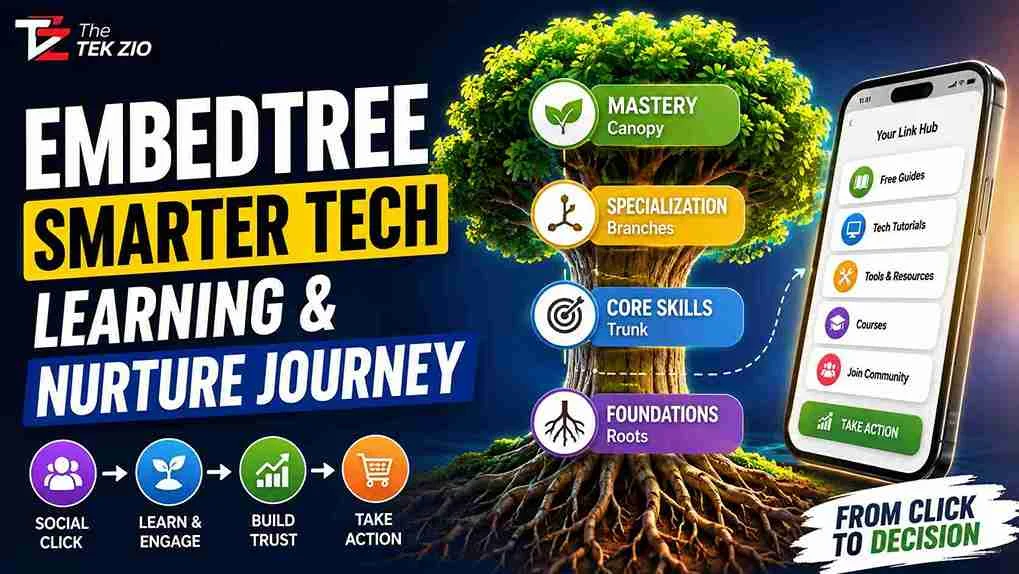
The idea borrows from how a tree develops, with foundations first and specialization later. It applies to two things at once: how you build your own tech skills, and how you walk an audience from a first click toward a decision. This post from The Tek Zio explains what the framework actually is, what it can and cannot do for your traffic and who should skip it entirely.
Quick Answer: Nurture Tech Tips EmbedTree is a tree-shaped method for organizing tech knowledge and content into stages: roots for foundations, trunk for core skills, branches for specialization and canopy for mastery. Applied to marketing, the same structure becomes a nurture campaign that moves a visitor from social media stuff to a real decision, instead of dumping every link at once.

What Nurture Tech Tips’ EmbedTree Actually Means
Nurture Tech Tips EmbedTree means organizing tech knowledge into ordered stages instead of scattered posts. That is the whole idea. The confusing part is that the phrase now covers two different things, and almost every page online blends them without saying so.
The first is a learning method. It describes how a person builds digital skills over months, starting with basics and adding specialization once the basics hold. Nurture tech tips in this sense are short lessons placed in a sensible order. The second is EmbedTree the product, a link in bio and content embedding platform where you put media directly on a hub page instead of listing plain URLs.
EmbedTree the company describes itself as an all-in-one place for your online presence, and that is a vendor description rather than an independent finding. Both meanings share the same tree logic, which is why searches for EmbedTree tech tips return results about learning frameworks and results about social media link organizer EmbedTree setups on the same page. Keep the two separate in your head. The method costs nothing. The product is software with its own limits.
The EmbedTree Learning Tree Explained
The EmbedTree learning tree is a four-stage model for structured tech learning. Each stage has to hold weight before the next one goes on top.
Definition: visual knowledge tree. A visual knowledge tree is a diagram where broad foundations sit at the bottom and narrow specialties branch off the top. Nothing appears higher up unless something below it supports it. In plain English, you cannot put leaves on air.
Roots (foundations). File systems, keyboard shortcuts, how a browser talks to a server, how to read an error message. Dull and load-bearing.
Trunk (core skills). The things you use every week no matter which job you hold. Spreadsheets, basic scripting, account security, data hygiene.
Branches (specialization). Where you pick a direction. Data analysis, front-end work, automation, security.
Canopy (mastery). Real projects with real consequences, plus keeping current as tools change.
The EmbedTree methodology treats microlearning tech tips as bricks rather than trivia. One tip on its own is forgettable. The same tip attached to a stage you are already working through tends to stick, because you have somewhere to put it. That is the difference between EmbedTree structured learning and watching a random tutorial at midnight.
How to Use EmbedTree for Tech Tips: Step by Step
Here is how to use EmbedTree for tech tips without ending up with the same cluttered mess you started with.
- Audit every link you currently share. List them in a spreadsheet. Most people find dead URLs and duplicates within ten minutes.
- Sort each link into a stage. Roots, trunk, branches or canopy. Anything that fits nowhere gets cut. This step removes the clutter that kills lead engagement.
- Create your hub page and customize it. Pick a template, then adjust color and layout so it matches your brand instead of the default.
- Embed the media, do not just link to it. EmbedTree pulls video and posts onto the page itself. Embedded content resolves through the oEmbed specification, a published standard that defines how one site requests a playable version of content hosted somewhere else.
- Name each node by outcome. “Fix a slow laptop in 10 minutes” beats “Blog post 14”. Naming is the cheapest conversion work you will ever do.
- Add one capture point, not five. A single email signup or a short form. More than one splits attention and lowers conversion rates.
- Connect analytics and tag your links. Add campaign parameters so your dashboard shows which node sends website traffic and which one sits dead.
- Schedule a monthly review. Check the metric that matters to you, prune dead branches and promote whatever earns clicks.
Managing multiple platforms gets easier once this is done, because you update the hub instead of rewriting every bio. If your workflow depends on phone-first publishing, the same sorting logic applies to the tools covered in our roundup of the best Android apps 2026.
EmbedTree vs Plain Link-in-Bio Tools
A plain link in bio tool shows text links. An embed hub shows the content itself. That single difference drives everything else in the table below.
| Capability | Plain link in bio tool | EmbedTree-style embed hub | Why it matters |
|---|---|---|---|
| What the visitor sees | A list of labels | Playable and readable content | Fewer decisions before engagement starts |
| Clicks to reach content | At least two | Often zero | Every extra click is an exit point |
| Media playback | Redirect to another app | Plays in place | Keeps attention on your page |
| Structure | Flat list | Staged tree | Supports a customer journey instead of a menu |
| Analytics depth | Click counts | Click counts plus per-node view data (vendor-stated) | You can tell which topic actually pulls |
| Page weight | Very light | Heavier because of third-party embeds | Heavy embeds risk failing Core Web Vitals on mobile |
Two rows deserve a warning. The analytics row reflects what EmbedTree states in its own marketing and has not been confirmed by an independent testing lab. The page weight row is not a vendor claim at all. It follows from how embeds work. Every embedded player loads code from another domain, so the more you add, the slower the page gets on a phone with a weak signal.
Turning the Tree Into a Nurture Campaign
A nurture campaign is a planned sequence that moves someone from mild curiosity toward a decision. The EmbedTree structure maps onto it almost exactly, which is why marketers keep finding this framework through search terms about learning.
Think about the stages again with a marketer hat on. Roots become awareness content that answers the question a prospect types at midnight. Trunk becomes education content that teaches the one concept they need before anything you sell makes sense. Branches become proof, including case studies and a white paper if you have one. Canopy becomes the point where a lead is ready to buy and you finally make an offer. That progression is standard lead nurturing. What EmbedTree adds is a single visible surface where all four stages sit in one place, so the sequence is browsable rather than trapped inside an inbox.
Email marketing is still the follow-through layer. The hub earns the address. Email campaigns do the patient work over the next few weeks. A successful nurture sequence usually beats a single blast because it matches the cycle stage the person is actually in, and because segmentation lets you send different next steps to a student and a buyer. Basic personalization here means using what you already know, not writing a novel. Dynamic content that swaps one paragraph based on which branch someone clicked is enough to lift lead engagement without a full marketing automation platform behind it.
For business to business work the picture shifts. B2B outreach on LinkedIn tends to send colder traffic, so the roots layer has to be genuinely useful before anyone gives you contact details. Lead scoring helps you sort a pipeline once volume grows, and simple lead management rules stop you from treating a first-time reader like someone ready to sign. Sales and marketing teams that align on what each stage means avoid the classic failure where marketing celebrates lead generation numbers while sales complains that nobody converts. Getting people to convert is a structural problem more often than a copywriting problem. Fix the order and the conversion follows.
One honest note about vocabulary. Vendors in this category love words like “seamless”, “all-in-one” and “game-changer”, and one calls its analytics a “leverage” point for growth. Those words tell you nothing about whether the tool fits your work. Judge it by whether it shortens the path from a click to a decision.
SEO, Website Traffic and Integration
An embed hub does very little for your own SEO, and anyone telling you otherwise is selling something. The hub sits on a third-party domain. Any authority it builds belongs to that domain, not to you.
That does not make it useless. It makes it a router. Use it to push people toward pages you own, where your landing page, your article and your product actually live. Send the traffic onward, then measure it. Add campaign parameters to every outbound node so your analytics separates hub traffic from everything else, and give each campaign a name you will still recognize in six months. Short links behave differently depending on the redirect type used, and the HTTP specification published as RFC 9110 defines a 301 as permanent and a 302 as temporary. That distinction affects how search engines treat the destination, so it is worth checking rather than assuming.
Integration is where most setups quietly break. A hub that does not talk to your email tool means somebody copies addresses by hand, which wastes the time the system was supposed to save. Check that connection before you commit to the platform. If your wider stack still runs on manual steps, our roundup of AI chatbots for business covers the front-end piece of the same problem.
AI Tools and Automation Inside the Journey
AI shortens the boring parts of this work and nothing else. That is a smaller promise than most software makes, and it is the accurate one.
- Sorting and tagging. Feed a list of your existing posts to a model and ask it to assign each one a stage. You will still correct roughly a third, and it saves time compared to starting blank.
- Drafting node labels. AI-generated titles give you twenty options to react to. Pick two.
- Summaries for each branch. A two-line description under every node raises click-through because visitors know what they are getting.
- Predictive prompts. Some marketing automation software claims to predict which lead is warming up. Treat any predictive score as a hint and not a verdict, since accuracy depends entirely on how much history the system has.
- Notification rules. Automate the alert that tells you when a node stops performing, then act on it.
Automation tech tips are worth applying in the order that saves the most hours first. Anything powered by AI still needs a human deciding what matters. If you want a broader AI tools learning path before you automate anything, start with the AI apps for productivity hub, and see best AI agents for productivity for the tools that run multi-step work without supervision.
Who It Solves Problems For
The framework helps different readers in different ways, and it helps some of them not at all.
- EmbedTree for creators. You publish on three or four platforms and lose people between them. A hub keeps your back catalog visible instead of buried under yesterday’s post.
- Tech tips for educators EmbedTree setups. A staged resource page beats a wall of links in a course description. Students see what comes next.
- Business tech tips EmbedTree use. Small teams get one shared surface for onboarding material, which cuts repeated questions.
- Nurture tech tips for startups. Early startup tech stack tips matter more than tool choice. Pick fewer tools, connect them properly and keep a lower cost base while you find out what works.
- Beginners. Nurture tech tips for beginners work best as one habit at a time. Digital literacy tips stick when they solve a problem you had this week.
Every one of these depends on having more than one destination worth visiting. If you have a single YouTube channel and nothing else, none of this applies yet.
Case Studies and Patterns Worth Copying
There are no independently verified case studies for EmbedTree, so nobody should be quoting conversion numbers at you. What exists is a set of patterns that show up repeatedly in published creator-marketing research, and those are worth copying.
- One offer per stage. Pages that ask for a single action at each level outperform pages that ask for four. Attention splits.
- Newest at the top, evergreen underneath. Fresh material earns the first click. Evergreen material earns the second one, which is the click that builds trust.
- Proof before the ask. Show the work, then invite the next step. Reversing the order raises bounce.
- One insight per node. A node that promises one clear thing gets opened. A node that promises everything gets ignored.
Any figure attached to these patterns in vendor marketing should be treated as unverified until a named source with a date backs it.
Nurture Tech Skills: A 90-Day Growth Path
If you want EmbedTree for digital skills growth rather than marketing, here is a plain schedule. It assumes about four hours a week.
- Weeks 1 to 4, roots. Learn your operating system properly, set up a password manager and get comfortable reading documentation. Write down every problem you hit.
- Weeks 5 to 8, trunk. Pick spreadsheets and one scripting language. Build two small things that solve a real annoyance in your own week.
- Weeks 9 to 12, branches. Choose one direction and go narrow. Ship something small that another person uses.
Track progress with a single number, such as problems you solved without help. That number moving is the only proof that matters. Readers who want a harder branch to aim at can start with quantum computing explained simply, and anyone heading toward development work should see how to use Gemini 3.5 Flash in coding.
Specs and Standards That Actually Apply
EmbedTree is a product, not a standard. It has no certification body and no published specification. What does apply are the open standards and regulations underneath it, and those you can check yourself.
- oEmbed 1.0 defines how a site fetches an embeddable version of content from another site. It is why a video plays inside your hub instead of opening elsewhere.
- The HTML iframe sandbox attribute, defined by the W3C and WHATWG, restricts what embedded third-party content can do inside your page. Isolation is a security feature, not a limitation.
- Core Web Vitals thresholds published by Google set the bar for a page rated as good: Largest Contentful Paint at or under 2.5 seconds, Interaction to Next Paint at or under 200 milliseconds and Cumulative Layout Shift at or under 0.1.
- RFC 9110, the current HTTP semantics specification, defines the difference between a permanent 301 redirect and a temporary 302.
- The CAN-SPAM Act, enforced by the U.S. Federal Trade Commission, and the UK Privacy and Electronic Communications Regulations, enforced by the Information Commissioner’s Office, govern what you may send once you collect an email address.
Stats and Data
| Data Point | Year | Source | Why It Matters |
|---|---|---|---|
| Good LCP is 2.5 seconds or less | 2024 | Google, web.dev | Heavy embeds are the most common reason a hub page misses it |
| Good INP is 200 milliseconds or less | 2024 | Google, web.dev | INP replaced First Input Delay as the responsiveness metric |
| Good CLS is 0.1 or less | 2024 | Google, web.dev | Embeds that load late push buttons around and cost you clicks |
| Commercial email must carry a valid physical address and a working opt-out | 2003, in force | U.S. Federal Trade Commission, CAN-SPAM Act | Applies the moment your hub starts collecting addresses |
Maximum civil penalties under CAN-SPAM are adjusted for inflation each year, so check the current FTC figure before quoting one. [VERIFY]

Common Mistakes and What Not to Do
- Dumping every link with no order. The visitor scans, finds no path and leaves. Nothing converts.
- Treating the hub as the destination. Your own website traffic never grows, and you build equity on somebody else’s domain.
- Embedding heavy media without checking load speed. Miss the Core Web Vitals thresholds and the page feels broken on a phone.
- Collecting emails with no consent language. That is a regulatory problem under CAN-SPAM in the U.S. and PECR in the U.K., not a style problem.
- Never pruning dead nodes. Broken links on a page carrying your brand cost more visibility than the extra content earns.
- Calling one broadcast post a campaign. One message is an announcement. A nurture campaign is a sequence with stages.
- Copying a competitor structure without adapting it. Their branches reflect their audience and not yours.
Reality Check: Will You Actually Notice the Difference
If you publish on one platform and sell nothing, a free link list is enough and Nurture Tech Tips EmbedTree changes nothing you can measure. The structure only starts paying you back once you have at least three content destinations and one thing you want people to do at the end.
That line is worth sitting with before you sign up for anything. The mechanics behind it are simple. Any benefit from an embed hub comes from removing clicks between a visitor and your content. If there is only one piece of content, there were no clicks to remove. Meanwhile the cost is real, since third-party embeds add page weight and every embed you stack pushes you closer to failing the load thresholds above. A creator with one channel takes the cost and gets none of the benefit.
The people who should see a difference are those currently losing traffic in the gaps. Four platforms, a newsletter and a product page, all connected by a single bio field that changes weekly. Fixing that is not glamorous. It is the unglamorous fix that usually works.
Who Should Use Which
Route the decision by what you actually run. A casual poster with one account needs nothing beyond the free link field the platform already gives you. A multi-platform creator gets the clearest benefit, because the hub replaces the constant bio rewriting and keeps older work reachable. An educator should use the staged structure but can host it on a normal web page if the school blocks third-party tools. A small sales and marketing team should decide first whether they need a real marketing automation platform, since a hub plus an email tool covers early needs at a much lower cost and a full platform only earns its price once volume and lead scoring genuinely matter.
The honest summary is that most readers can start with the free version of whatever they already use. Upgrade when a specific limit blocks you and not before.
Wrapping Up
The tree only matters if it ends somewhere. Nurture Tech Tips EmbedTree gives you an order to put things in, and order is what turns a pile of links into something a person can walk through. Start by cutting what nobody opens. Then decide what you want the last click to do. If the answer is nothing yet, keep the free link field and spend the time making the content better instead. When you are ready to connect the rest of your workflow, our AI apps for productivity hub covers the tools that handle the follow-up work once the structure is in place.
How The Tek Zio Researches
The Tek Zio does not operate a test lab and does not perform in-house hardware or software testing. This article draws on published open standards from the W3C and the oEmbed specification, performance thresholds published by Google, and regulatory documentation from the U.S. Federal Trade Commission and the U.K. Information Commissioner’s Office. All product feature and pricing statements are attributed to the vendor and have not been independently confirmed. Where a figure could not be sourced, it is marked rather than published. Last checked August 18, 2026.
Related Posts
Frequently Asked Questions
What is Nurture Tech Tips EmbedTree?
Nurture Tech Tips EmbedTree is a framework that organizes tech knowledge and content into four stages modeled on a tree: roots for foundations, trunk for core skills, branches for specialization and canopy for mastery. It is used both for personal skill building and for structuring content so an audience moves through it in order. The name also refers to EmbedTree, a content embedding platform.
Is EmbedTree a link in bio tool or a learning framework?
Both, and the overlap causes most of the confusion online. EmbedTree the product is a link in bio and content hub where media plays directly on the page. The EmbedTree learning tree is a method for ordering skills and lessons. You can apply the method with no software at all, using a normal page on your own site.
How do I use EmbedTree for tech tips?
Audit your existing links, sort each one into a stage, build the hub page, embed the actual media rather than plain URLs and name every node by the outcome it delivers. Add one capture point, tag your outbound links so analytics can separate them and review performance monthly. Cut whatever nobody opens.
Is EmbedTree free?
EmbedTree markets both free and paid tiers, and specific limits change without notice. The Tek Zio does not publish pricing for this platform because vendor pages are the only source and they update frequently. Check the official EmbedTree site directly before committing, and confirm what the free tier allows for links, analytics and branding.
Can EmbedTree help SEO or website traffic?
Not directly. A hosted hub page sits on a third-party domain, so any ranking authority it earns stays there rather than transferring to your site. It can still raise your website traffic by routing visitors to pages you own. Treat it as a router toward your content and never as a replacement for it.
How does an EmbedTree nurture campaign improve conversion?
By matching content to the stage a visitor is in. Someone arriving from a short video is not ready to buy, so showing them a purchase link wastes the click. A staged structure offers education first, proof second and an offer last. That order usually lifts conversion rates because fewer people are asked for a decision too early.
Does EmbedTree work with email marketing?
It can, provided the platform connects to your email tool or exports cleanly. The hub collects the address and your email campaigns do the follow-up work over the following weeks. Confirm the integration before you build anything, since a broken connection means somebody transfers contacts by hand every week.
Is EmbedTree good for beginners?
Yes, for beginners with something to organize. The setup requires no coding and the templates handle layout. If you currently share one link and publish in one place, you will not notice a difference. The framework rewards people managing multiple destinations, not people starting their first account.
How is EmbedTree different from a normal link organizer?
A normal organizer displays clickable text. EmbedTree displays the content itself using embeds, so visitors watch or read without leaving. The trade is page weight, because each embed loads code from another domain. Fewer embeds load faster. The structural difference matters more than the visual one, since a staged tree supports a journey.
How long until a nurture campaign shows results?
Expect weeks rather than days, and judge it on movement rather than a single number. Early signals include a rising share of visitors who open more than one node and a slow increase in email replies. If nothing has moved after two full months, the problem is usually stage order and not copy.


